Saturday, February 15, 2020

"Contributed Tirades"


My contribution is "Contributed Tirades". I wonder if I have ever had any Invited Tirades?

Thanks to Dan Larremore for the inspiration!

Tuesday, February 04, 2020

Dodgers Acquire Mookie Betts (and David Price)!

The Dodgers have acquired Mookie Betts in a trade with the Boston Red Sox! In addition to Betts, we get David Price, who is still a good pitcher (although he is worth much less than his hefty salary these days). Alex Verdugo goes to the Red Sox and Kenta Maeda goes to the Minnesota Twins, who are sending prospect Brusdar Graterol to the Red Sox.

Wow!

Update: And right after the big trade above, the Dodgers traded Joc Pederson to the Los Angeles Angels for infielder Luis Rengifo.

Update (2/09/20): After the original version of the trade hit a snag (because of a medical test on Brusdar Graterol), the Dodgers, Red Sox, and Twins have now officially agreed on a trade (so it's now a done deal). Our trades with the Red Sox and Twins are now two separate deals, and a couple of other Dodger prospects (shortstop Jeter Downs and catcher Connor Wong) are now also going to the Red Sox.

Update (2/09/20): The Dodgers also get another prospect and a draft pick from the Twins, and (according to David Schoenfield) the trade of Joc Pederson to the Angels (which apparently was contingent on the trade for Betts) appears to be a casualty of the delay in finalizing the trade for Betts.

Monday, February 03, 2020

"Online Reactions to the 2017 ‘Unite the Right’ Rally in Charlottesville: Measuring Polarization in Twitter Networks Using Media Followership"

A new paper of mine came out in final form a few days ago. Here are some details.

Title: Online Reactions to the 2017 ‘Unite the Right’ Rally in Charlottesville: Measuring Polarization in Twitter Networks Using Media Followership

Authors: Joseph H. Tien, Marisa C. Eisenberg, Sarah T. Cherng, and Mason A. Porter

Abstract: Network analysis of social media provides an important new lens on politics, communication, and their interactions. This lens is particularly prominent in fast-moving events, such as conversations and action in political rallies and the use of social media by extremist groups to spread their message. We study the Twitter conversation following the August 2017 ‘Unite the Right’ rally in Charlottesville, Virginia, USA using tools from network analysis and data science. We use media followership on Twitter and principal component analysis (PCA) to compute a ‘Left’/‘Right’ media score on a one-dimensional axis to characterize Twitter accounts. We then use these scores, in concert with retweet relationships, to examine the structure of a retweet network of approximately 300,000 accounts that communicated with the #Charlottesville hashtag. The retweet network is sharply polarized, with an assortativity coefficient of 0.8 with respect to the sign of the media PCA score. Community detection using two approaches, a Louvain method and InfoMap, yields communities that tend to be homogeneous in terms of Left/Right node composition. We also examine centrality measures and find that hyperlink-induced topic search (HITS) identifies many more hubs on the Left than on the Right. When comparing tweet content, we find that tweets about ‘Trump’ were widespread in both the Left and Right, although the accompanying language (i.e., critical on the Left, but supportive on the Right) was unsurprisingly different. Nodes with large degrees in communities on the Left include accounts that are associated with disparate areas, including activism, business, arts and entertainment, media, and politics. By contrast, support of Donald Trump was a common thread among the Right communities, connecting communities with accounts that reference white-supremacist hate symbols, communities with influential personalities in the alt-right, and the largest Right community (which includes the Twitter account FoxNews).

Note: And only now after several rounds of page proofs, right after it's too late, do I notice that the typesetters changed "Right" to "right" in the paper title, even though it is a proper noun. Well, we had plenty of chances to notice this typo that they introduced, so it's frustrating that this is another one of those that I notice immediately as soon as it's published (while not catching it in my numerous chances to see it).

Tuesday, January 28, 2020

Boycotting a Coin Over a "Missing" Oxford Comma

Perhaps Philip Pullman is overreacting in his boycott of a coin over a missing Oxford comma, but this does pull at my heart strings. :)

(Tip of the cap to Sam Howison.)

Monday, January 27, 2020

"Quantifying “Political Islands” with Persistent Homology"

Here is a new expository article (in SIAM News) by my Ph.D. student Michelle Feng and me about our work on spatial topological data analysis.

You may also be interested in our associated research article and our recent follow-up article.

Saturday, January 25, 2020

New 2020 Baseball Hall of Famers

I am a bit late with this post, as I have been traveling and very busy during the past few days.

Anyway, the new Major League Baseball Hall of Famers that were just elected by the writers are Derek Jeter (in his first year of eligibility) and Larry Walker (in his 10th and final year on the writers' ballot). I'm really pleased that Larry Walker was voted in by the writers! He should have made it years ago, but thankfully he made huge gains in each of the last three years (and especially in each of the last two years). For Jeter, the only question was whether he'd be unanimous; one person left him off of their ballot. Jeter and Walker join Ted Simmons and Marvin Miller as 2020's inductees into the Hall of Fame.

This year's vote totals are available at this website, and you can also take a look at the Hall of Fame Voter Tracker, which I was following assiduously in the weeks leading up to the announcement of the new inductees.

Scott Rolen was polling at close to 50% before the results were announced. He gained a ton of votes, but after seeing where he was before the announcement, I was a bit surprised to see the final total at "only" about 35%. Todd Helton made major gains to almost 30%, perhaps because he's no longer on his first ballot. They're in good shape, but it will take a while.

Curt Schilling got to 70%, so he'll make it in 2021. Nobody who has a shot is debuting on the ballot next year (well, maybe Tim Hudson will make it eventually), so 2021 is Schilling's year.

Rogers Clemens and Barry Bonds crept over 60%. I'll be very surprised if the writers elect them, as people have drawn lines in the sand, but one of the current incarnations of the Veterans Committees will put them in the Hall someday.

Omar Vizquel (sigh) broke the 50% barrier, and his eventual election is inevitable.

Billy Wagner, Gary Sheffield, and Andruw Jones made big gains. (I wonder if the latter two were helped not only by there being only one obvious newcomer but also by Harold Baines now being in the Hall? Both Jones and Sheffield were much better players than Baines.) We'll see how much Wagner gains over the next years.

Jeff Kent also made major inroads, and he'll likely make it eventually via one of the Veterans Committees.

A bunch of others (such as Manny Ramirez and Sammy Sosa) also gained a decent amount, but I doubt they'll go much of anywhere on the regular ballot (and Sosa has achieved around this many votes in some past years as well, I believe).

Bobby Abreu managed to get just enough votes to stay on the ballot next year. That's good.

And the latest entries in the exactly-one-vote club are Adam Dunn, Brad Penny, Raúl Ibañez, and J. J. Putz (who once hit Kevin Mench with a pitch, marking the only time in Major League Baseball history that a Mench got hit by a Putz).
There aren't any Hall-of-Fame-caliber standouts debuting on the 2021 ballot, so perhaps it will only be Curt Schilling from the regular ballot next year.

David Schoenfield wrote about this year's winners and losers in the Hall of Fame voting.

Here is my blog entry about the result of last year's writers' votes.

Wednesday, January 22, 2020

What Happens in Kuala Lumpur Stays in Kuala Lumpur

I just arrived in Kuala Lumpur for a friend's wedding!

I am very tired. :)

Saturday, January 18, 2020

Quote of the Conference: Geodesic Spaces of Normal Shrinkage

"I call it 'geodesic spaces of normal shrinkage', in honor of George Costanza."

This may be the quote of the conference. The talk in question is this one.

Wednesday, January 15, 2020

Depeche Mode is in the Rock & Roll Hall of Fame!

Depeche Mode has been inducted into the Rock & Roll Hall of Fame! Yay!

Also: It's about time!

Tuesday, January 14, 2020

What Happens at the Joint Mathematics Meetings Stays at the Joint Mathematics Meetings (2020 Edition)

I am heading over to the Joint Mathematics Meetings! I am looking forward to spending less time horizontal than was the case at my last JMM.

Also, here is the schedule of talks from my group (and a friend of my group).

Love Will Tear Us Apart: Geographic Edition


(Tip of the cap to Dan Anderson.)

Monday, January 06, 2020

Wednesday, January 01, 2020

A Band Called "f(x)"

I know nothing about the band — and K-Pop isn't exactly my style anyway — but I definitely like the band's name!

Tuesday, December 31, 2019

The End of a Decade, with a Fair Starting Day

I'll let you know when my decade ends.

To do that, I'll first need to figure out when it started. ;)

Now, which starting point will allow me to maximize or minimize something interesting...

Oh, never mind; let's do this with a random-number generator: I get 2017.55793, which rounding to the nearest day (I'll round up), gives me a start to my decade of the 204th day of 2017.

My decade apparently started on 23 July 2017, so talk to me in 2027 about the end of my decade.

P.S. Happy New Year! (Well, in a few hours.)

Tales from the ArXiv: How Many Updates is the Record?

Well, the answer to the question that I posed two years ago was apparently "yes", but the authors did eventually stop uploading updates of their paper to arXiv after another three weeks or so (and five more updates).

I wonder if 16 versions of a paper is an arXiv record?

Saturday, December 28, 2019

Social Seismology: The Chutzpah Scale

Tuesday, December 24, 2019

Emoji Differential Equations: Dreidels as Euler Angles

Here is my latest set of emoji differential equations.

Saturday, December 21, 2019

The Three Alternative Branches of Government

Really?

Thursday, December 19, 2019

TMNTing Wikipedia Pages: A Twitter Account

This is the right type of Twitter account. ;)

(Tip of the cap to Evelyn Lamb.)

Tuesday, December 17, 2019

"A Two-Patch Epidemic Model with Nonlinear Relapse"

Another of my papers came out in final form today. Here are some details.

Title: A Two-Patch Epidemic Model with Nonlinear Relapse

Authors: Juan G. Calvo, Alberto Hernández, Mason A. Porter, and Fabio Sanchez

Abstract (English version): The propagation of infectious diseases and its impact on individuals play a major role in disease dynamics, and it is important to incorporate population heterogeneity into efforts to study diseases. As a simplistic but illustrative example, we examine interactions between urban and rural populations on the dynamics of disease spreading. Using a compartmental framework of susceptible–infected–susceptible (SIŜ) dynamics with some level of immunity, we formulate a model that allows nonlinear reinfection. We investigate the effects of population movement in a simple scenario: a case with two patches, which allows us to model population movement between urban and rural areas. To study the dynamics of the system, we compute a basic reproduction number for each population (urban and rural). We also compute steady states, determine the local stability of the disease-free steady state, and identify conditions for the existence of endemic steady states. From our analysis and computational experiments, we illustrate that population movement plays an important role in disease dynamics. In some cases, it can be rather beneficial, as it can enlarge the region of stability of a disease-free steady state.

Note: The published paper also has a Spanish version of the abstract.

Monday, December 16, 2019

What Happens in Vancouver Stays in Vancouver (2019 Edition)

Today I'll be flying to Vancouver for a few days to visit a friend who I haven't seen in three years. Uncharacteristically for me, I am planning on this being an actual holiday (although I do hope to mostly keep up with simple e-mails to prevent feeling overwhelmed upon my return).

We'll be binge-gaming, and in particular we are going to get as far as we can through Pandemic Legacy: Season 1, which was a gift from my one of recently-finished doctoral students. (The gift actually helped provide an impetus for this trip to happen, as getting a regular set of players for a 'legacy' or other campaign is not easy for me.)

As I'll be playing a Pandemic game, I guess I won't be escaping from networks entirely. :)

Saturday, December 14, 2019

Agent-Based Models with Emoji

This app lets one simulate cellular automata with emoji!

This may inspire some snark. Possibly.

(Tip of the cap to Alice Schwarze.)

Friday, December 13, 2019

Best Journal Spam E-Mail Ever?


(Tip of the cap to Laura Kubatko.)

Tuesday, December 10, 2019

Tales from the ArXiv: The "Chicken McNugget Monoid"

Yes, there really is a mathematical object called the "Chicken McNugget Monoid", and here is a screenshot from page one of the paper.


Apparently, this comes from the standard nugget counts in boxes of Chicken McNuggets. Here is one line from the paper: Under regular integer addition, ⟨6,9,20⟩ forms a monoid, meaning the sum of any two McNugget numbers is again a McNugget number. And if this sounds like something out of The Onion, you may be interested in this recent article.

Also, in case you were wondering: Using [17, Proposition 1 and Table 1], it follows that the Frobenius number of 🐤 is 43. This is the largest number of Chicken McNuggets that cannot be ordered using whole boxes of sizes 6, 9, or 20.


"Effect of Antipsychotics on Community Structure in Functional Brain Networks"

We finally have our final coordinates for the published version of this paper, which was an exercise in extreme persistence — the human kind, not the mathematical kind — of the first author Ryan Flanagan. He has maintained a superlative attitude and desire to do this work in the fact of much adversity. Here are some details about the paper.

Title: Effect of Antipsychotics on Community Structure in Functional Brain Networks

Authors: Ryan Flanagan, Lucas Lacasa, Emma K. Towlson, Sang Hoon Lee, and Mason A. Porter

Abstract: Schizophrenia, a mental disorder that is characterized by abnormal social behaviour and failure to distinguish one’s own thoughts and ideas from reality, has been associated with structural abnormalities in the architecture of functional brain networks. In this article, we (1) investigate whether mesoscale network properties give relevant information to distinguish groups of patients from controls in different scenarios and (2) use this lens to examine network effects of different antipsychotic treatments. Using various methods of network analysis, we examine the effect of two classical therapeutic antipsychotics—Aripiprazoleand Sulpiride—on the architecture of functional brain networks of both controls (i.e., a set of people who were deemed to be healthy) and patients (who were diagnosed with schizophrenia). We compare community structures of functional brain networks of different individuals using mesoscopic response functions, which measure how community structure changes across different scales of a network. Our approach does a reasonably good job of distinguishing patients from controls, and the distinction is sharper for patients and controls who have been treated with Aripiprazole. Unexpectedly, we find that this increased separation between patients and controls is associated with a change in the control group, as the functional brain networks of the patient group appear to be predominantly unaffected by this drug. This suggests that Aripiprazole has a significant and measurable effect on community structure in healthy individuals but not in individuals who are diagnosed with schizophrenia, something that conflicts with the naive assumption that the drug alters the mesoscale network properties of the patients (rather than the controls). By contrast, we are less successful at separating the networks of patients from those of controls when the subjects have been given the drug Sulpiride. Taken together, in our results, we observe differences in the effects of the drugs (and a placebo) on community structure in patients and controls and also that this effect differs across groups. From a network-science perspective, we thereby demonstrate that different types of antipsychotic drugs selectively affect mesoscale properties of brain networks, providing support that structures such as communities are meaningful functional units in the brain.

Monday, December 09, 2019

"Customer Mobility and Congestion in Supermarkets"

One of my papers just came out in final form. Here are the details.

Title: Customer Mobility and Congestion in Supermarkets

Authors: Fabian Ying, Alisdair O. G. Wallis, Mariano Beguerisse-Díaz, Mason A. Porter, & Samuel D. Howison

Abstract: The analysis and characterization of human mobility using population-level mobility models is important for numerous applications, ranging from the estimation of commuter flows in cities to modeling trade flows between countries. However, almost all of these applications have focused on large spatial scales, which typically range between intracity scales and intercountry scales. In this paper, we investigate population-level human mobility models on a much smaller spatial scale by using them to estimate customer mobility flow between supermarket zones. We use anonymized, ordered customer-basket data to infer empirical mobility flow in supermarkets, and we apply variants of the gravity and intervening-opportunities models to fit this mobility flow and estimate the flow on unseen data. We find that a doubly-constrained gravity model and an extended radiation model (which is a type of intervening-opportunities model) can successfully estimate 65%–70% of the flow inside supermarkets. Using a gravity model as a case study, we then investigate how to reduce congestion in supermarkets using mobility models. We model each supermarket zone as a queue, and we use a gravity model to identify store layouts with low congestion, which we measure either by the maximum number of visits to a zone or by the total mean queue size. We then use a simulated-annealing algorithm to find store layouts with lower congestion than a supermarket’s original layout. In these optimized store layouts, we find that popular zones are often in the perimeter of a store. Our research gives insight both into how customers move in supermarkets and into how retailers can arrange stores to reduce congestion. It also provides a case study of human mobility on small spatial scales.

Sunday, December 08, 2019

Tales from the ArXiv: Modeling Stupid People

I am intrigued by this paper, which is called Cipolla’ s game: playing under the laws of human stupidity.

Here is a screenshot to whet your appetite.

Marvin Miller and Ted Simmons are in the Hall of Fame!

Marvin Miller (about damn time) and Ted Simmons (about damn time) have been selected to be in Major League Baseball's Hall of Fame!

I look forward to seeing people like Lou Whitaker eventually get in as well!

(Given the Harold Baines debacle from last year, there was basically no chance for me to be as annoyed about the 'Veterans Commitee' selections as I was last year at this time.)

Update: The article above has now been updated with the vote totals. Simmons got 13 votes and Miller got 12, and Dwight Evans was next with 8. The rest of the vote totals are as follows: "Dave Parker received seven votes, and Steve Garvey and Lou Whitaker six each. Tommy John, Don Mattingly, Thurman Munson and Dale Murphy all got three or fewer."

Saturday, December 07, 2019

Karate Clubbuccino (Take 2)

Here is take 2 of the Karate Clubbuccino, which is otherwise known as using a cappuccino embedding to depict the Zachary Karate Club network. (Thanks to Sofia Piltz for making this happen.)


Below is take 1.

Friday, December 06, 2019

The Devil's Mathematical Dictionary

Thursday, December 05, 2019

A Black Box with Weights on the Inside

I approve! ;)

(Tip of the cap to Adrienne Porter Felt [no relation].)

A Very Cool Science Cake about Soil


(Tips of the cap to Anne Jefferson and Meghan Duffy.)

Thursday, November 28, 2019

My TDA (Topological Data Analysis) Origin Story

Based on what I saw as an undergraduate, I thought that algebraic topology was hopelessly abstract, and then I encountered Konstantin Mischaikow's work when I was a postdoc at Georgia Tech. He was using these ideas to analyze experimental data from areas like fluid mechanics. This stuck in my head, but I didn't work on these topics for many years. However, it stuck in the back of my head for about a decade, as this had made an impression on me. (I was aware of work of some others as well, but this is the one that made an impression, because of the close collaboration with experimentalists.) I was spending a bunch of time on granular networks as well as on generalizing network analysis from graphs to various more complicated structures (and I also had the desire to look more at "higher-order" interactions more generally).

During one of my daily arXiv routines, I noticed a paper by Konstantin and collaborators that used topological data analysis (TDA), so I saw that we were looking at the same systems, but in different ways. I contacted him, visited him early in 2013, and we started a joint TDA project --- but it turned out to be on spreading dynamics on networks, rather than on granular networks. Our first paper (which was led by Dane Taylor and coauthored with many other excellent people, including my Oxford colleague Heather Harrington) was published in final form in Nature Communications in 2015. I viewed this as just one paper; I never intended to start a large new direction in my research program. Back at Oxford, one student saw that I was part of that and wanted to work with Heather and me on applications of TDA. Then more students saw the 2015 paper and what this student was doing, and they wanted to work with us on TDA.

After I moved to UCLA, more students (starting with Michelle Feng) saw that I had some papers on TDA and wanted to work with me on those topics, partly because they wanted to do things with applications but also wanted to continue pursuing more theoretical mathematical subjects as well. I also really like the idea of taking "traditionally pure" areas of mathematics and bringing more and more of them into applications. It's a really exciting thing to do. And the work on applications also yields really great insights into the mathematical theory. (Because it does go in both directions, after all.)

Most recently, at least among people who have officially joined my group, Abby Hickok saw the work that Michelle and I have been doing, and she has ideas for building further on that work. And now TDA (along with work involving the intersection of dynamics, networks, and simplicial complexes) has become an important part of my research program,

Anyway, it was an all an accident.

Wednesday, November 27, 2019

Facial Recognition Software for Sheep

This is classical improbable research. This is extremely useful for many things, so first it may make you laugh, but then it makes you think.


(Tip of the cap to Richard Parker.)

A Golden Age of Mathematics: Happening Right Now!

Monday, November 25, 2019

Tales from the ArXiv: Mathematics Paper or Science-Fiction Novel?

A new paper, which looks very fascinating, that just appeared on arXiv is called Tropical Principal Component Analysis on the Space of Ultrametrics.

Tropical PCA sounds very promising and fascinating. Additionally, I think the title of this paper would make a great title for a science-fiction novel.

Saturday, November 23, 2019

Data Analysis of Exuberant and Uncouth College Fight Songs

Fivethirtyeight.com did some data analysis of college fight songs.

UCLA's fight song is apparently called "Sons of Westwood" (ugh).


How can they write such an article without mentioning Tom Lehrer?

Friday, November 22, 2019

Tetris with Gelatin

This is so awesome!

Wednesday, November 20, 2019

Some of my Past Materials Related to Academic Job Applications and Related Things

I've gotten an e-mail from someone indicating that the job-related materials that I have posted have been helpful to them, so this is a good impetus for me to broadcast them again in case others find them useful.

It's Applied-Mathematician Season

Or possibly duck season?

Tuesday, November 19, 2019

AirBnB Rental of a Pirate Ship on the Mississippi River

If I ever find myself with a conference or other event in the Minneapolis–St. Paul area of Minnesota, I may well partake of staying in a pirate ship. Yarrrrr!

Monday, November 18, 2019

LaTeX Without Hats

Technically, with hats.

Note: I think that the official lyrics have "We can..." in the first line that I show, but when Men Without Hats sing it, it does sound somewhat like they include an extra de facto syllable.

Update (11/19/19): I did a copy-and-paste and clearly should have looked a bit more for a better website. I didn't even notice the "They're are" until I saw Ernie Barreto's comment on Facebook. Here is a better site.

Sunday, November 17, 2019

Thursday, November 14, 2019

2019 Most Valuable Player Awards

Major League Baseball has announced the 2019 Most Valuable Player awards, and it's a southern California affair: Cody Bellinger of the Los Angeles Dodgers won in the National League (damn right!), and Mike Trout of the Los Angeles Angeles (of Anaheim) won in the American League (good!).

You can find the vote tallies of all players who received MVP votes on this page, and you can take a look at ESPN's summary of this season's awards in Major League Baseball on this page.

A New Paper (and a Great Meta-Acknowledgement) on the Cost of Formatting in Scientific Papers

I am very amused. :)

Wednesday, November 13, 2019

2019 Cy Young Awards

The 2019 Cy Young Awards, for the best pitching performances in the American and National League, were announced today by Major League Baseball. In the American League, Justin Verlander of the Houston Astros edged out teammate Gerrit Cole. (It would have been really cool if they had tied, but I agree that Verlander is a slightly better choice as the winner.) In the National League, Jacob DeGrom won in a landslide over Hyun-Jin Ryu and Max Scherzer (who were tied for 2nd place), who were barely ahead of Jack Flaherty. Stephen Strasburg finished in 5th place, and he was within striking distance of Flaherty.

You can read ESPN's summary of this week's Major Baseball Awards on this page.

Tuesday, November 12, 2019

2019 Managers of the Year

The 2019 Managers of the Year in Major League Baseball are Mike Shildt (of the St. Louis Cardinals) in the National League and Rocco Baldelli (of the Minnesota Twins) in the American League.

ESPN is tabulate this week's award winners on this page.

Monday, November 11, 2019

Tales from the ArXiv: "Tautological Algebra"

I feel like tautological algebra is what we get from many of our students.

2019 Rookies of the Year

Unsurprisingly, Pete Alonso of the New York Mets and Yordan Álvarez of the Houston Astros were runaway winners of Rookie of the Year in the National League and American League, respectively.

Take a look at this page for a tabulation of Major League Baseball's 2019 awards. Today's announcement of the Rookies of the Year kicks off a week of pronouncements. The three finalists for each award were announced previously.

Update: The vote tallies are available at this page.

Sunday, November 10, 2019

Paper Title of the Day: "p-ing Everywhere"


(Tip of the cap to Chris Marcum.)

Saturday, November 09, 2019

Visualization of the Zachary Karate Club Network Using a Cappuccino Embedding


Sofia found this picture in one of Petter Holme's presentations, although it reminds me of one of them from old papers and t-shirt designs.

Wednesday, November 06, 2019

Tales from the ArXiv: An Epic 1-Panel Figure

Chris Lustri just pointed me to Figure 1 (see below) in this paper. Although it doesn't have 81 panels, it is awesome in its own way.

Monday, November 04, 2019

"Supracentrality Analysis of Temporal Networks with Directed Interlayer Coupling"

A new book chapter in the edited book Temporal Network Theory was just published in final form. Here are some details.

Titles: Supracentrality Analysis of Temporal Networks with Directed Interlayer Coupling

Authors: Dane Taylor, Mason A. Porter, and Peter J. Mucha

Abstract: We describe centralities in temporal networks using a supracentrality framework to study centrality trajectories, which characterize how the importances of nodes change in time. We study supracentrality generalizations of eigenvector-based centralities, a family of centrality measures for time-independent networks that includes PageRank, hub and authority scores, and eigenvector centrality. We start with a sequence of adjacency matrices, each of which represents a time layer of a network at a different point or interval of time. Coupling centrality matrices across time layers with weighted interlayer edges yields a supracentrality matrix ℂ(𝜔), where ω controls the extent to which centrality trajectories change over time. We can flexibly tune the weight and topology of the interlayer coupling to cater to different scientific applications. The entries of the dominant eigenvector of ℂ(𝜔) represent joint centralities, which simultaneously quantify the importance of every node in every time layer. Inspired by probability theory, we also compute marginal and conditional centralities. We illustrate how to adjust the coupling between time layers to tune the extent to which nodes’ centrality trajectories are influenced by the oldest and newest time layers. We support our findings by analysis in the limits of small and large ω.

Sunday, November 03, 2019

7th Century: Service Obligations Interfering with Research and Teaching

Some things never change...

(Tip of the cap to multiple people.)

Friday, November 01, 2019

"Challenge Accepted"


(Tip of the cap to Card Colm Mulcahy.)

Thursday, October 31, 2019

Tonight is a Night for Spectral Graph Theory

Monday, October 21, 2019

Sunday, October 20, 2019

What Happens in Washington, D.C. Stays in Washington, D.C.

I suppose that truer words were never written.

In any event, today I am heading off to Washington, D.C. to principal-investigator workshop that is related to a new NSF grant of mine.

On Thursday, I'll be giving a seminar in the Department of Mathematical Sciences at George Mason University. It will be Mason@Mason — a fixed point!

Friday, October 18, 2019

A Beautiful Map of Mathematics


For details of the construction, see this page.

I am — literally! — all over the map.

Wednesday, October 16, 2019

A Skirt Made of Rejection Letters


(Tip of the cap to Petter Holme.)

Tuesday, October 08, 2019

Friday, October 04, 2019

Tales from the ArXiv: Awesome First Sentence

The first sentence of the abstract of this paper is wonderful!

In case you're wondering, it is from this song

Tuesday, October 01, 2019

Charles Babbage and "Street Nuisances"

Wow!

Monday, September 30, 2019

Cool Art: Geometric Flat Lays from Kristen Meyer

Kristen Meyer's art is really cool!

Take a look at her Instagram page. Among her particularly nice pieces is this one.

Sunday, September 29, 2019

Dodgers Win Franchise-Record 106 Games!

Today was the last day of Major League Baseball's 2019 regular season, and the Dodgers won their franchise-record 106th game!

Clayton Kershaw pitched a scoreless inning in relief, although his earned run average remained above 3.00 (he would have needed to pitch 3 scoreless innings to get below 3.00), after a Major-League-record 10 consecutive seasons with an ERA less than 3.00. (The number 10 depends on a certain minimum number of innings pitched, so one can quibble with exactly how one should count things.) The second-largest consecutive streak, by Greg Maddux and at least one other, encompasses seven straight seasons.

It was a very nice touch when Madison Bumgarner, in possibly his last game as a Giant, had a pinch-hitting appearance against Clayton Kershaw in the 5th inning.

Also, today was the last game in Bruce Bochy's managerial career. He had announced long ago — before the beginning of the season, I think — that 2019 would be his final season. He'll be entering the Hall of Fame as a manager.

Spaceballs: The Billboard

Wow! This is so awesome!


(Tip of the cap to Jerry Sharp.)

Wednesday, September 25, 2019

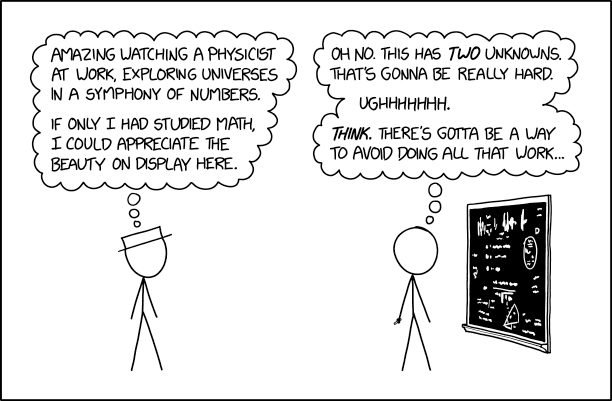
XKCD: Math Work

Today's xkcd is highly amusing.


Fact check: True √

Alexa: Coming Soon with Samuel L. Jackson's Voice

Soon there is going to be the option for Alexa to have Samuel L. Jackson's voice.

The possibilities are glorious.

However, it may still not be as cool as Samuel J. Jackson as the voice of God when reading from the bible.

Headline of the Day: Blasphemy Edition

The headline of this article is worth its weight in gold.

The headline (in the preview, as seen on a Facebook post): Irish police drop Stephen Fry blasphemy investigation due to 'lack of outraged people'

The headline in the article itself is of the same spirit (and still great), but the wording is slightly different.

P.S. Don't ask me how much a headline weighs.

(Tip of the cap to whoever posts on behalf of the Douglas Adams page on Facebook.)

Update: Note that the article is from 2017, so it is not new news.

Tuesday, September 24, 2019

"Forecasting Failure Locations in 2-Dimensional Disordered Lattices"

One of my papers (which we published in PNAS) now has its final coordinates (volume, page numbers, etc.), after previously being posted in 'advanced access'. Here are some details about the article.

Title: Forecasting Failure Locations in 2-Dimensional Disordered Lattices

Authors: Estelle Berthier, Mason A. Porter, and Karen E. Daniels

Abstract: Forecasting fracture locations in a progressively failing disordered structure is of paramount importance when considering structural materials. We explore this issue for gradual deterioration via beam breakage of 2-dimensional (2D) disordered lattices, which we represent as networks, for various values of mean degree. We study experimental samples with geometric structures that we construct based on observed contact networks in 2D granular media. We calculate geodesic edge betweenness centrality, which helps quantify which edges are on many shortest paths in a network, to forecast the failure locations. We demonstrate for the tested samples that, for a variety of failure behaviors, failures occur predominantly at locations that have larger geodesic edge betweenness values than the mean one in the structure. Because only a small fraction of edges have values above the mean, this is a relevant diagnostic to assess failure locations. Our results demonstrate that one can consider only specific parts of a system as likely failure locations and that, with reasonable success, one can assess possible failure locations of a structure without needing to study its detailed energetic states.

Significance Statement: Disordered lattices are used widely for mechanical applications because they are lightweight and robust. Due to their heterogeneous structure, it is a complicated task to understand and forecast their progressive degradation. To safely use these materials and design structures with optimized mechanical properties, it is crucial to understand where failures occur. We show that a simple test that consists of comparing the importance of a beam with respect to the other beams in a lattice permits a successful forecast of the locations of failures. It allows one to consider only a small fraction of the beams as likely failure locations. Our approach also provides a roadmap for studies of failures in other spatial networks.

Monday, September 23, 2019

Saturday, September 21, 2019

What Happens When You Finish a PhD in Complex Systems

No cynicism or snark at all. :P

(By the way, I have been enjoying various instances of this meme that I have encountered during the last couple of days.)

Wednesday, September 18, 2019

I Have "NoIDEA"

Journal Idea: "Nonlinear Integro-Differential Equations and Applications" (NoIDEA)

It turns out that there is a journal called Nonlinear Differential Equations and Applications and that the acronym it uses is "NoDEA".

I feel inspired!

I am going to start a journal called "Nonlinear Integro-Differential Equations and Applications", and its acronym will be "NoIDEA"!

A Very Large Roll of the Dice (for a Very Large Fireball)

Last Friday (September 13th), a truck turned too sharply, spilling about 216,000 six-sided dice "onto Interstate 75 in Atlanta in what could be the biggest unintentional dice roll ever."

I love the last line of the article: "The truck was undamaged, having made its saving throw."

Note: It would be quite a fireball to require this many d6 rolls!

Note 2: The article title is annoying, as the "perfect" comment is plain wrong. And the 756,000 number doesn't even come from a role. It is estimate based on an equal probability of each outcome for each die and an estimate of the number of dice.

Update: It occurs to me: I'm going to turn this incident into a problem for my mathematical-modeling course.

Tuesday, September 17, 2019

New Journal Paper: "The Value of Thoughts and Prayers"

A new study, which was just published in PNAS, is called "The Value of Thoughts and Prayers". It considers the monetary value of thoughts and prayers, as quantified in psychology experiments.

This paper seems very worthy of an Ig Nobel Prize, though just seeing the title of it mostly makes me feel sad, despite its amusing (and 'improbable') nature.

(Tip of the cap to Bruno Gonçalves.)

Sunday, September 15, 2019

Pictures from Beijing, China (September, 2019)

Here are many pictures from my trip to Beijing, China in September 2019.

RIP Ric Ocasek (1944–2019)

Ric Ocasek, the lead singer of The Cars, died today.

He was older than I thought, although their debut album is from the 1970s, so this age does make sense. I like several of their songs quite a bit, and my favorite is probably "You Might Think".

(Tip of the cap to Misty Beaird‎.)

Update (9/16/19): There is a nice obituary in The New York Times. (Tip of the cap to Diana Thomas.)

Friday, September 13, 2019

2019 Ig Nobel Prizes

The 2019 Ig Nobel Prizes have been announced. I really like the one for medicine (which was awarded to Silvano Gallus, for collecting evidence that pizza might protect against illness and death, if the pizza is made and eaten in Italy), and the physics one (making Patricia Yang and David Hu second-time Ig Nobel laureates) is a familiar study about why wombats have cubic poo. David Hu and his group regularly do a lot of cool, quirky projects.

Maybe I will get one in one of these years...

Friday, September 06, 2019

Turing Clouds: Some Awesome Mathematical Art

My college friend Blake Jones has written up his efforts (including some awesome videos and stills) about Turing clouds.

Here are a couple of stills from Blake's website.

The site has plenty of videos and stills, as well as some behind-the-hood blurbs with lay descriptions of some of
the math and computer science.

Wednesday, September 04, 2019

A History of Tetris Randomizers

This article about randomizers in the game Tetris is very cool!

(Tip of the cap to Mike Cook.)

Sunday, September 01, 2019

A LaTeX Typesetting Game

I am amused.

Saturday, August 31, 2019

What Happens in Beijing Stays in Beijing

I am off to China for the first time since 2010, and this time I'll be visiting Beijing.

Wednesday, August 28, 2019

Quiz: Guess the Paper Topic from the Last Line of the Abstract

Here is the last line of a recent paper's abstract: Moreover, this work presents a new and computationally non-expensive method to account for shrinkage.

Your job is to guess the topic of the paper. (In case you want to cheat, you can look at the paper.)

Monday, August 26, 2019

RIP KFOG 104.5

It was announced today that KFOG 104.5 is soon going to stop playing its brand of music and will instead simulcast from its sister sports station KNBR.

After KSCA 101.9's brief adult-alternative format died (it too broadcast The Dr. Demento Show) and it was possible to get radio stations from around the country over the internet, I listened to KFOG (which had a similar format, as well as Dr. D) a good amount for a while. Whenever my Mac would die and I didn't have access to iTunes for a while, KFOG was a also a station that I sought out during the dry spells.

Alas, as announced today, KFOG is switching formats after many years. It's a pity. In many ways, it's a natural progression — I, and many others, meet our musical needs differently nowadays — but it still makes me feel a bit sad.

Incidentally, it was through 101.9 and the aforementioned format that I first heard a song by Loreena McKennitt.

Sunday, August 25, 2019

Emoji Expression

I think that I was pretty clever with this one. :)

I hope that some of you will be able to figure out the song.

Tuesday, August 20, 2019

Very Cool Artwork of Light and Shadow

Kumi Yamashita's art with light and shadow is very cool!

Friday, August 16, 2019

Cicadas and Amusing Lab Hijinks

I am amused!

(Tip of the cap to Lindsey N. Walker.)

Thursday, August 15, 2019

Trying to Trademark the Word "The"

THE Ohio State University is apparently trying to trademark the word "the". Oy vey.

I love University of Michigan's response on Twitter.

Wednesday, August 14, 2019

List: "Critically Acclaimed Horror Film of the 2010s or Your Ph.D. Program"

Well, this list is both amusing and cynical (with several loud rings of truth, unfortunately).

(Tip of the cap to Suzanne Sindi.)

Monday, August 12, 2019

What Happens at WorldCon Stays at WorldCon

I am heading over to Dublin for this year's WorldCon!

My schedule is below.

Saturday, August 10, 2019

One of my Favorite Oxonian Ironies: 5 Years Ago Today

Thursday, August 08, 2019

Friday, August 02, 2019

Critical-Failure Dice

I need to get myself some of these critical-failure dice, which replace the "1" (for critical misses, of course) in the 20-sided die by the f-word. I want some!

And I especially like the new rainbow version of these dice!

Update (8/05/19): My dice arrived today!

Thursday, August 01, 2019

Gerrymandering Fonts