Monday, November 15, 2021

2021 Baseball Rookies of the Year

The 2021 Rookies of the Year were announced today. Jonathan India of the Cincinnati Reds won in the National League, and Randy Arozarena of the Tampa Bay Rays won in the American League.

Neither choice is surprising.

Some More Trips

I have had a few more short academic trips in the last couple of weeks. I spent a day at Harvey Mudd to talk to the students in Heather Zinn Brooks's class on mathematics and democracy. Then I took a trip to Michigan state to give an applied-mathematics colloquium, and now I am in San Diego State to give a mathematics colloquium.

Wednesday, November 10, 2021

Major League Relievers of the Year

The Mariano Rivera Award and Trevor Hoffmann Award have been awarded to the top relievers in the American League and National League, respectively. Liam Hendricks of the Chicago White Sox won the former, and Josh Hader of the Milwakuee Brewers won the latter.

Friday, November 05, 2021

"Pull Out All the Stops: Textual Analysis via Punctuation Sequences"

One of my papers, which has been available publicly for more than a year, is finally out in final form, with its coordinates (its page numbers and so on). Here are the details.

Title: Pull Out All the Stops: Textual Analysis via Punctuation Sequences

Authors: Alexandra N. M. Darmon, Marya Bazzi, Sam D. Howison, and Mason A. Porter

Abstract: Whether enjoying the lucid prose of a favourite author or slogging through some other writer's cumbersome, heavy-set prattle (full of parentheses, em dashes, compound adjectives, and Oxford commas), readers will notice stylistic signatures not only in word choice and grammar but also in punctuation itself. Indeed, visual sequences of punctuation from different authors produce marvellously different (and visually striking) sequences. Punctuation is a largely overlooked stylistic feature in stylometry, the quantitative analysis of written text. In this paper, we examine punctuation sequences in a corpus of literary documents and ask the following questions: Are the properties of such sequences a distinctive feature of different authors? Is it possible to distinguish literary genres based on their punctuation sequences? Do the punctuation styles of authors evolve over time? Are we on to something interesting in trying to do stylometry without words, or are we full of sound and fury (signifying nothing)?

In our investigation, we examine a large corpus of documents from Project Gutenberg (a digital library with many possible editorial influences). We extract punctuation sequences from each document in our corpus and record the number of words that separate punctuation marks. Using such information about punctuation-usage patterns, we attempt both author and genre recognition, and we also examine the evolution of punctuation usage over time. Our efforts at author recognition are particularly successful. Among the features that we consider, the one that seems to carry the most explanatory power is an empirical approximation of the joint probability of the successive occurrence of two punctuation marks. In our conclusions, we suggest several directions for future work, including the application of similar analyses for investigating translations and other types of categorical time series.

Friday, October 15, 2021

"Detection of Functional Communities in Networks of Randomly Coupled Oscillators Using the Dynamic-Mode Decomposition"

One of my papers just came out in final form last week. Here are some details.

Title: Detection of Functional Communities in Networks of Randomly Coupled Oscillators Using the Dynamic-Mode Decomposition

Abstract: Dynamic-mode decomposition (DMD) is a versatile framework for model-free analysis of time series that are generated by dynamical systems. We develop a DMD-based algorithm to investigate the formation of functional communities in networks of coupled, heterogeneous Kuramoto oscillators. In these functional communities, the oscillators in a network have similar dynamics. We consider two common random-graph models (Watts–Strogatz networks and Barabási–Albert networks) with different amounts of heterogeneities among the oscillators. In our computations, we find that membership in a functional community reflects the extent to which there is establishment and sustainment of locking between oscillators. We construct forest graphs that illustrate the complex ways in which the heterogeneous oscillators associate and disassociate with each other.

Thursday, October 14, 2021

Dodgers Advance to the National League Championship Series!

The Dodgers beat the Giants 2–1 in the elimination game of the NLDS to advance to the National League Championship Series against the Braves!!!

Today was game 5 of the National League Division Series. We were tied 1–1 entering the 9th inning and scored one run in the top of the inning. Max Scherzer entered the game in the bottom of the 9th and earned a save.

The called strike on the check swing to end the game was a really bad call.

Wednesday, October 06, 2021

Dodgers Win Wild Card Elimination Game on a Walk-Off Homerun!

The Dodgers have just beaten the Cardinals in the Wild Card elimination game!

We'll be going to face the Giants (in our first ever postseason series against them) in the National League Division Series!

The Dodgers and Giants had the two best records during the regular season.

Sunday, October 03, 2021

Some Baseball Musings on the Last Day of the 2021 Regular Season

Despite some possibilities for drama, there won't be any Game 163 for any teams. (There was late-inning drama in two of the relevant AL games today, and that is why there won't be any of these extra games.)

We (i.e., the Dodgers) have a win-or-go-home Wild Card 'playoff' against the Cardinals on Wednesday. I'll have it on silent at first while I am participating as a panelist in the UCLA math department job-application panel (which I suggested to our department head that we should do, and thankfully we're doing it), and then I'll have sound on for most of the game once the panel is over.

Trea Turner ended up winning the NL battle title handily. I have trouble picking an MVP, because I think the Padres going into the tank will hurt Tatis Jr.'s chances. That said, I still think he merits it, although if we're going to do pure performance after the Padres fall, maybe Juan Soto ultimately was somewhat better overall? The NL Cy Young award is hard to predict, as a lot of votes will get split. Right now, I think it will be Walker Buehler by a nose over Scherzer, Burnes, and Zack Wheeler. Urías will get some down-ballot votes, but despite the gaudy win totals, the other pitchers I mentioned (and some I have not) have been better them him. Jonathan India will when the NL ROY.

In the AL, Ohtani is the MVP. I think Gerrit Cole is a slightly better Cy Young choice than Robbie Ray, who many announcers seem to think is the heavy favorite. He's a good choice, but I think that Cole has been slightly better. Randy Arozarena is technically still a rookie, but I think I need to look more closely at some of the other viable options as well.

Finally, reports of Joey Votto's demise appear to have been greatly exaggerated (although he has changed his hitting style).

Wednesday, September 15, 2021

"Math Prof" (a parody of “Dentist” from Little Shop of Horrors)

“Math Prof”

(a parody of “Dentist” from Little Shop of Horrors)

[MATHEMATICS PROFESSOR]
When I was younger, just a small geeky kid,
My mama noticed nerdy things I did,
Like countin' all the lights in the ceilings
I'd find their patterns, and after these things
I'd create a small maze and see where it led
That's when my mama said

[POSTDOCS]
What did she say?

[MATHEMATICS PROFESSOR]
She said, "My boy, I think someday
You'll find a way
To make your natural tendencies pay
You'll be a math prof
You have a talent for countin’ things up
Son, be a math prof
People will pay you to be all stuck-up
Your temperament's wrong for the priesthood
And business would suit you still less
Son, be a math prof
You'll be a success

[POSTDOCS]
Here he is, folks, the leader of the proof!
Watch him be oh so aloof!
Oh, my god!
He's a math prof and he'll never ever be any good
Who wants a thesis defense with someone in that mood?

[STUDENT]
Oh that hurts! I don’t know!

[MATHEMATICS PROFESSOR]
Oh, shut up. Think faster. Now go!
I am your math prof

[STUDENT]
Goodness gracious!

[MATHEMATICS PROFESSOR]
And I enjoy the career that I picked

[POSTDOCS]
Really love it

[MATHEMATICS PROFESSOR]
I am your math prof

[STUDENT]
Proving theorems

[MATHEMATICS PROFESSOR]
And I get off on the pain I inflict

[POSTDOCS]
Really love it

[MATHEMATICS PROFESSOR]
I thrill when I ask a tough question

[POSTDOCS]
Tough question
[MATHEMATICS PROFESSOR]
It's swell though they tell me I'm maladjusted
And though it may cause my students distress,
Somewhere, somewhere in Heaven above me
I know, I know, that my mama's proud of me
Oh, mama
'Cause I'm a math prof and a success
Say pi!

[STUDENT]
Pi!

[MATHEMATICS PROFESSOR]
Say mu!

[STUDENT]
Mu!

[MATHEMATICS PROFESSOR]
Say nu!

[STUDENT]
Nu!

[MATHEMATICS PROFESSOR]
Now prove it!
Thursday, September 09, 2021

2021 Ig Nobel Prizes!

The 2021 Ig Nobel laureates have been announced!

I think my favorite one this year is the prize in chemistry, but I of course have fondness for the winners in complex systems (especially with one of them published in Physical Review E).

Thursday, August 26, 2021

What Happens in Boulder Stays in Boulder

I am taking my first trip since January 2020!

I'll be visiting CU Boulder to give an applied-mathematics colloquium. This will also be only my second in-person presentation (I gave one at IPAM a couple of weeks ago) since the start of the pandemic.

I haven't been to Boulder since around 2003 or 2004. I am looking forward to my trip, although traveling is even more nerve-wracking than before.

Friday, August 06, 2021

"Social Network Analysis for Social Neuroscientists"

A paper of mine that was posted in advanced access more than a year ago has now finally been posted in final form. It is a survey and perspective article on social network analysis for social neuroscientists. Here are some details.

Title: Social Network Analysis for Social Neuroscientists

Authors: Elisa C. Baek, Mason A. Porter, and Carolyn Parkinson

Abstract: Although social neuroscience is concerned with understanding how the brain interacts with its social environment, prevailing research in the field has primarily considered the human brain in isolation, deprived of its rich social context. Emerging work in social neuroscience that leverages tools from network analysis has begun to advance knowledge of how the human brain influences and is influenced by the structures of its social environment. In this paper, we provide an overview of key theory and methods in network analysis (especially for social systems) as an introduction for social neuroscientists who are interested in relating individual cognition to the structures of an individual’s social environments. We also highlight some exciting new work as examples of how to productively use these tools to investigate questions of relevance to social neuroscientists. We include tutorials to help with practical implementations of the concepts that we discuss. We conclude by highlighting a broad range of exciting research opportunities for social neuroscientists who are interested in using network analysis to study social systems.

Friday, July 30, 2021

Dodgers Acquire Max Scherzer and Trea Turner!

The Dodgers have made a huge splash in the trade market: they have acquired Max Scherzer and Trea Turner from the Washington Nationals for a load of prospects. This is exactly the trade that we needed. Scherzer, who will eventually be a Hall of Famer, is still an excellent and durable starter; and Turner is an outstanding infielder (who is also rather underrated, in my view, even amidst the wide recognition of his excellence), and I wouldn't be surprised if he eventually also makes the Hall of Fame. Just before then, the Dodgers also acquired pitcher Danny Duffy from the Royals.

Note: I didn't post this yesterday because I wanted to wait until the deal with the Nationals was done, rather than being something that the Dodgers were "finalizing".

Tuesday, July 27, 2021

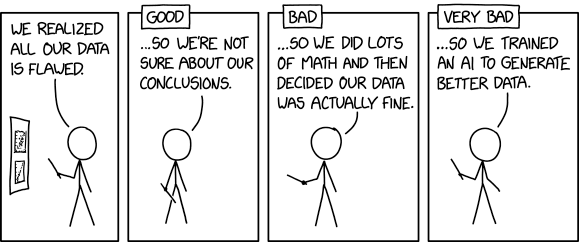
XKCD and Flawed Data

XKCD nailed it yet again, especially with the mouseover text.

Friday, July 16, 2021

My Current Mathematics Genealogy

Here is my current mathematics genealogy.

Thursday, July 08, 2021

"Tie-Decay Networks in Continuous Timeand Eigenvector-Based Centralities"

The paper based on one of my old projects finally appeared in final form. Here are some details.

Title: Tie-Decay Networks in Continuous Timeand Eigenvector-Based Centralities

Authors: Walid Ahmad, Mason A. Porter, and Mariano Beguerisse-Díaz

Abstract: Network theory is a useful framework for studying interconnected systems of interacting entities. Many networked systems evolve continuously in time, but most existing methods for the analysis of time-dependent networks rely on discrete or discretized time. In this paper, we propose an approach for studying networks that evolve in continuous time by distinguishing between interactions, which we model as discrete contacts, and ties, which encode the strengths of relationships over time. To illustrate our tie-decay network formalism, we adapt the well-known PageRank centrality score to our tie-decay framework in a mathematically tractable and computationally efficient way. We apply this framework to a synthetic example and then use it to study a network of retweets during the 2012 National Health Service controversy in the United Kingdom. Our work also provides guidance for similar generalizations of other tools from network theory to continuous-time networks with tie decay, including for applications to streaming data.

Monday, June 28, 2021

"Opinion Dynamics on Tie-Decay Networks"

A new paper of mine just came out in final form. Here are some details.

Title: Opinion Dynamics on Tie-Decay Networks

Authors: Kashin Sugishita, Mason A. Porter, Mariano Beguerisse-Díaz, and Naoki Masuda

Abstract: In social networks, interaction patterns typically change over time. We study opinion dynamics on tie-decay networks in which tie strength increases instantaneously when there is an interaction and decays exponentially between interactions. Specifically, we formulate continuous-time Laplacian dynamics and a discrete-time DeGroot model of opinion dynamics on these tie-decay networks, and we carry out numerical computations for the continuous-time Laplacian dynamics. We examine the speed of convergence by studying the spectral gaps of combinatorial Laplacian matrices of tie-decay networks. First, we compare the spectral gaps of the Laplacian matrices of tie-decay networks that we construct from empirical data with the spectral gaps for corresponding randomized and aggregate networks. We find that the spectral gaps for the empirical networks tend to be smaller than those for the randomized and aggregate networks. Second, we study the spectral gap as a function of the tie-decay rate and time. Intuitively, we expect small tie-decay rates to lead to fast convergence because the influence of each interaction between two nodes lasts longer for smaller decay rates. Moreover, as time progresses and more interactions occur, we expect eventual convergence. However, we demonstrate that the spectral gap need not decrease monotonically with respect to the decay rate or increase monotonically with respect to time. Our results highlight the importance of the interplay between the times that edges strengthen and decay in temporal networks.

Thursday, May 20, 2021

"Topological Data Analysis of Task-Based fMRI Data from Experiments on Schizophrenia"

Another of my papers from an old project final came out in final form after a very long road. Here are some details.

Title: "Topological Data Analysis of Task-Based fMRI Data from Experiments on Schizophrenia"

Authors: Bernadette J. Stolz, Tegan Emerson, Satu Nahkuri, Mason A. Porter, and Heather A Harrington

Abstract: We use methods from computational algebraic topology to study functional brain networks in which nodes represent brain regions and weighted edges encode the similarity of functional magnetic resonance imaging (fMRI) time series from each region. With these tools, which allow one to characterize topological invariants such as loops in high-dimensional data, we are able to gain understanding of low-dimensional structures in networks in a way that complements traditional approaches that are based on pairwise interactions. In the present paper, we use persistent homology to analyze networks that we construct from task-based fMRI data from schizophrenia patients, healthy controls, and healthy siblings of schizophrenia patients. We thereby explore the persistence of topological structures such as loops at different scales in these networks. We use persistence landscapes and persistence images to represent the output of our persistent-homology calculations, and we study the persistence landscapes and persistence images using k-means clustering and community detection. Based on our analysis of persistence landscapes, we find that the members of the sibling cohort have topological features (specifically, their one-dimensional loops) that are distinct from the other two cohorts. From the persistence images, we are able to distinguish all three subject groups and to determine the brain regions in the loops (with four or more edges) that allow us to make these distinctions.

Tuesday, May 18, 2021

"Counterparty Credit Limits: The Impact of a Risk-Mitigation Measure on Everyday Trading"

A paper of mine (from an extremely old project) final came out in final form today. Here are some details.

Title: Counterparty Credit Limits: The Impact of a Risk-Mitigation Measure on Everyday Trading

Authors: Martin D. Gould, Nikolaus Hautsch, Sam D. Howison, and Mason A. Porter

Abstract: A counterparty credit limit (CCL) is a limit that is imposed by a financial institution to cap its maximum possible exposure to a specified counterparty. CCLs help institutions to mitigate counterparty credit risk via selective diversification of their exposures. In this paper, we analyse how CCLs impact the prices that institutions pay for their trades during everyday trading. We study a high-quality data set from a large electronic trading platform in the foreign exchange spot market that allows institutions to apply CCLs. We find empirically that CCLs had little impact on the vast majority of trades in this data set. We also study the impact of CCLs using a new model of trading. By simulating our model with different underlying CCL networks, we highlight that CCLs can have a major impact in some situations.

Friday, May 07, 2021

"Random-Graph Models and Characterization of Granular Networks"

A paper of mine from 2020 now has its final coordinates listed on the published file itself. Here are some details.

Title: Random-Graph Models and Characterization of Granular Networks

Authors: Silvia Nauer, Lucas Böttcher, and Mason A. Porter

Abstract: Various approaches and measures from network analysis have been applied to granular and particulate networks to gain insights into their structural, transport, failure-propagation and other systems-level properties. In this article, we examine a variety of common network measures and study their ability to characterize various two-dimensional and three-dimensional spatial random-graph models and empirical two-dimensional granular networks. We identify network measures that are able to distinguish between physically plausible and unphysical spatial network models. Our results also suggest that there are significant differences in the distributions of certain network measures in two and three dimensions, hinting at important differences that we also expect to arise in experimental granular networks.