Wednesday, July 18, 2018
Tales from the ArXiv: Don't Feed Random Walkers After Midnight
Quoting from the abstract: "The model is highly versatile, as the motion of the walkers can be fed on topological properties of the nodes..."
Comment: But don't feed them after midnight.
Dodgers Trade for Manny Machado!
With Corey Seager out for the year, having Machado to play shortstop the rest of the year is most excellent indeed!
Tuesday, July 17, 2018
Medieval Fantasy City Generator
I also wonder if it uses any generative-model ideas from urban analytics and/or complex systems?
(Tip of the cap to Dungeons and Dragons Memes.)
Monday, July 16, 2018
Heart and Caffeine Plushies
Here are my two latest @GIANTmicrobes plushies: Heart and Caffeine
— Mason Porter (@masonporter) July 17, 2018
The heart is particularly adorable. pic.twitter.com/LV1IuVCWf5
"Message-Passing Methods for Complex Contagions"
Friday, July 13, 2018
Creating Wikipedia Entries for Underrepresented Scientists and Engineers
Meet @jesswade, a scientist working to increase the number of underrepresented scientists and engineers on @Wikipedia: https://t.co/4JAJirmWDp #WomenInSTEM @WikiWomenInRed pic.twitter.com/f6jiX47WLL
— Wikimedia (@Wikimedia) July 13, 2018
Wednesday, July 11, 2018
Titles
On some website pop-up menus, there are so many possible titles that it's really hard to choose the most appropriate one to use.
— Mason Porter (@masonporter) July 11, 2018
(Click to see the full list. Some selections are cut off.) pic.twitter.com/mRgnGMMxkd
Real-Life Elliptical Billiard Table
Now we just need real-life Sinai and stadium billiards (and, of course, a mushroom billiard, to make Lyonia happy).
Unveiling the elliptical pool table designed by @AlexBellos captured local imagination: https://t.co/BlSu2PQ95m , https://t.co/bPVtkHF6Bh , https://t.co/MPAdoNv8pU . 1st in North America, 3rd in the world. Planning formal event at @WaterlooMath in the fall.
— Stephen M. Watt (@Stephen_Watt) July 11, 2018
(Tip of the cap to Alex Bellos.)
Update: The table pictured in the article appears to be a circle, rather than a more general ellipse.
Algorithmic Author Ordership
I have never laughed out loud reading a journal article, until I saw this little gem from Lakens, Scheel, and Isager (2018). Talk about total transparency!https://t.co/4eAsdvFbMI pic.twitter.com/OsVUTYf71e
— Stacy T. Shaw 🇭🇷 (@StacyTShaw) July 11, 2018
Tuesday, July 10, 2018
Awesome Close-Up Photos of Snails
Ukrainian photographer Vyacheslav Mishchenko catches these unbelievably stunning up-close photographs of snails pic.twitter.com/Lhgj2zcx6S
— Life on Earth 🌴 (@planetepics) July 10, 2018
(Tip of the cap to Invisible Scientist.)
Thursday, July 05, 2018
My Eponymous Agent-Based-Model (ABM) Simulator
Interested in #MASON for agent-based modeling? Check out our new paper: The MASON Simulation Toolkit: Past, Present, and Future. More details @ https://t.co/II9TFkQ7SU The link also points you to a lot of new demo models for GIS & ABM pic.twitter.com/8OnbC5ckud
— Andrew Crooks (@AndyCrooks) July 4, 2018
(Tip of the cap to Sang Hoon Lee.)
Tuesday, July 03, 2018
"My" Eponymous Band
And now, on this occasion, even the band itself accidentally tagged me in their Facebook post instead of themselves!
Rock on! ("Folk on?")
One of these years, I seriously need to crash one of their shows with a short mathematics lecture.
Monday, July 02, 2018
"International Conference on Newfangled Methods"
They're not even trying anymore. How sad. pic.twitter.com/rHrk905Kex
— Grace Lindsay (@neurograce) July 1, 2018
Sunday, July 01, 2018
What Happens in Newcastle Stays in Newcastle (2018 Edition)
Thursday, June 28, 2018
RIP Harlan Ellison (1934–2018)
Here is a picture with him at Dragon*Con in 2003. He complimented me on the shirt I was wearing, and rolled his eyes to signal to me (while I was waiting patiently at the front of the line) that the person in front of me in line for his autograph (who gave him tons and tons of things to sign) was an idiot. For me, he signed a well-read copy of the 35-year retrospective of his work, and he agreed to be in the picture below. Unlike recent Dragon*Cons, Ellison's autograph was free. He seemed to appreciate the fact that I had obviously read the book that I asked him to sign.
Update: Here is an obituary from The Nerdist.
Tuesday, June 26, 2018
Another Living Network
Parasitic crustacean, Dendrogaster sp. found on the seastar, Mediaster brachiatus. Collected at depth of 300m, Kumanonada-sea, Japan. pic.twitter.com/uy2J3FD2dk
— M (@manpokenautilus) June 25, 2018
Other examples of living networks are fungal networks.
(Tip of the cap to Jessica Rosenkrantz.)
Monday, June 25, 2018
"Detecting Sarcasm with Deep Convolutional Neural Networks"
Detecting Sarcasm with Deep Convolutional Neural Networks https://t.co/C05UdMjCoe pic.twitter.com/q50x9QqXhD
— KDnuggets (@kdnuggets) June 24, 2018
(Tip of the cap to Peter Rothman.)
Sunday, June 24, 2018
Yet Another Amazing Tiling from Tiling Bot
I strongly recommend looking through Tiling Bot's feed.
#Hyperbolic #tiling shown vertex-centered in the orthographic model. Truncated {3,12}. pic.twitter.com/tpsPWqOBOi
— Tiling Bot (@TilingBot) June 24, 2018
Saturday, June 23, 2018
What Happens in Oxford Stays in Oxford
I'll also be participating and speaking at Howison-fest, a workshop in honor of Sam Howison's 60th birthday.
Thursday, June 21, 2018
"FU" Stands for "Fundamental Unit"
Remember: "FUs are biologically well defined".
This screenshot is from this new paper.
(Tip of the cap to Alex Vespignani.)
Ground Control to Major Tom: Perfect Photographic Timing
Perfect timing. pic.twitter.com/4bVoqBHoH2
— You Had One Job (@_youhadonejob1) June 20, 2018
Wednesday, June 20, 2018
Poincaré Disk: Fantasy Edition
A surface obtained by gluing six heptagons. Universal cover in the Poincaré model (the same character shown = the same point of the surface). Weapons to show that this is not orientable (it has Euler characteristic -1). Constructed by DivisionByZero [ https://t.co/zgD3J7pG4f ] pic.twitter.com/J1MzJKCkYl
— Zeno Rogue (@ZenoRogue) June 20, 2018
A Bulging Visual Illusion
The image appears to bulge out, though it consists of squares aligned vertically and horizontally. pic.twitter.com/uwb0HJPyiw
— Akiyoshi Kitaoka (@AkiyoshiKitaoka) June 20, 2018
(Tip of the cap to Ben Orlin.)
Scholarship: Part of the Scientific Reward System
Also: scholarship ;)
— DynamicalSystemsSIAM (@DynamicsSIAM) June 20, 2018
Tuesday, June 19, 2018
Apple Seismology
Quoting the article's lead: Just as an earthquake’s seismic waves reveal properties of Earth’s interior, elastic surface waves on an apple can tell us about what’s going on inside the fruit.
This research may be a contender for an Ig Nobel prize.
Update: Apple seismology was discussed originally in a 1973 mathematical modeling paper by J.R. Cooke and Richard Rand. (This paper is cited in the Physics Today article above.)
An Alternative to a Faculty Retreat
#justsaying
Hitting a Major League Home Run Before One's First Major League Home Run
Quoting from the article to which I linked:
On Monday, the Washington Nationals rookie crushed a tiebreaking, pinch-hit, two-run homer against the New York Yankees in the continuation of a game that started May 15 — five days before his big league debut.
According to the Elias Sports Bureau, Soto's blast will not be considered his first major league homer, but it will be counted as a home run hit on May 15.
Saturday, June 16, 2018
"Female Drosophila melanogaster Respond to Song-Amplitude Modulations"
Title: Female Drosophila melanogaster Respond to Song-Amplitude Modulations
Authors: Birgit Brüggemeier, Mason A. Porter, Jim O. Vigoreaux,and Stephen F. Goodwin
Abstract: Males in numerous animal species use mating songs to attract females and intimidate competitors. We demonstrate that modulations in song amplitude are behaviourally relevant in the fruit fly Drosophila. We show that Drosophila melanogaster females prefer amplitude modulations that are typical of melanogaster song over other modulations, which suggests that amplitude modulations are processed auditorily by D. melanogaster. Our work demonstrates that receivers can decode messages in amplitude modulations, complementing the recent finding that male flies actively control song amplitude. To describe amplitude modulations, we propose the concept of song amplitude structure (SAS) and discuss similarities and differences to amplitude modulation with distance (AMD).
Thursday, June 14, 2018
Adrián Beltré Now has More Hits than All Other Non-US-Born Players
He passed Ichiro in the game that ended a few hours ago.
Saturday, June 09, 2018
Sunday, June 03, 2018
Excellent Notation for Predator–Prey Dynamics
LaTeX is so much better when you have emoji. pic.twitter.com/SYxgUXpWYN
— Mike Bostock (@mbostock) June 2, 2018
(Tip of the cap to Karen Daniels.)
Triumphant Return of The Power Law Shop
I'm happy to announce the triumphant return of The Power Law Shop!https://t.co/1sgZacqhhv
— Mason Porter (@masonporter) June 3, 2018
Just in time for #netsci2018 (@netsci2018).
We're trying to fill a universal and critical need for scale-free swag.
Saturday, June 02, 2018
Jack and Jill had Issues
Well, I just didn’t realise that Jack and Jill had so many mishaps as well as falling down the hill. Here are some, as recounted in this little 1806 chap book, just 212 years ago https://t.co/SnLDtBTCia pic.twitter.com/mBkro0bvmn
— Journal of Art in Society (@artinsociety) June 3, 2018
Mathematics is an Experimental Science
'Mathematics is an experimental science, and definitions do not come first, but later on.' -- Oliver Heaviside
— Analysis Fact (@AnalysisFact) June 1, 2018
(Tip of the cap to Steve Strogatz.)
Friday, June 01, 2018
A Brief Celebration of #NationalDonutDay
In honor of #NationalDonutDay, which is apparently today.
— Mason Porter (@masonporter) June 1, 2018
Also with some #topologicalentropy
P.S. There is a day for everything. pic.twitter.com/3zze0exZJr
Thursday, May 31, 2018
Tales from the ArXiv: "Calculating Spherical Harmonics Without Derivatives"
A part that some of you may find interesting is the pedagogical discussion at the beginning of Section 5, which starts: "Historically, there are five ways that spherical harmonics can be derived."
The one that is easiest (by far) for me to understand is the oldest method, which is by solving the differential equation. But I am mathematically inclined, and people with more physical intuition may prefer other methods.
(People who are more comfortable than I am with Lie manipulations may also prefer other approaches.)
Anyway, I appreciate the discussion in this paper.
Sunday, May 27, 2018
"Can Multilayer Networks Advance Animal Behavior Research?"
Title: Can Multilayer Networks Advance Animal Behavior Research?
Authors: Matthew J. Silk, Kelly R. Finn, Mason A. Porter, and Noa Pinter-Wollman
Abstract: Interactions among individual animals — and between these individuals and their environment — yield complex, multifaceted systems. The development of multilayer network analysis offers a promising new approach for studying animal social behavior and its relation to eco-evolutionary dynamics.
Thursday, May 24, 2018
Innovative Pitching Usage: Micro-Starts by Relievers
The Rays are doing this again in their upcoming series against the Orioles.
I think there is a lot of traction for more of this, though it will depend on a team's rotation (e.g., if you have one like the Astros, this is probably not as helpful as for the Rays), player, player egos, and so on.
Tuesday, May 22, 2018
What Happens at Caltech Stays at Caltech
Thursday, May 17, 2018
"The Pole Arm of Archaeology" and Other Epic Scholar Visualizations
"The Pole Arm of Archaeology" (1977) #WorstAcademicDiagrams pic.twitter.com/l8pwq6XYdF
— Dan Hicks (@ProfDanHicks) May 16, 2018
(Tip of the cap to Brian Cox.)
Tuesday, May 15, 2018
'Working Paper' in Collaboration with International Monetary Fund: "Evolution of the Global Financial Network and Contagion: A New Approach"
Title: Evolution of the Global Financial Network and Contagion: A New Approach
Authors: Yevgeniya Korniyenko, Manasa Patnam, Rita Maria del Rio-Chanon, and Mason A. Porter
Abstract: This paper studies the interconnectedness of the global financial system and its susceptibility to shocks. A novel multilayer network framework is applied to link debt and equity exposures across countries. Use of this approach—that examines simultaneously multiple channels of transmission and their important higher order effects—shows that ignoring the heterogeneity of financial exposures, and simply aggregating all claims, as often done in other studies, can underestimate the extent and effects of financial contagion.The structure of the global financial network has changed since the global financial crisis, impacted by European bank’s deleveraging and higher corporate debt issuance. Still, we find that the structure of the system and contagion remain similar in that network is highly susceptible to shocks from central countries and those with large financial systems (e.g., the USA and the UK). While, individual European countries (excluding the UK) have relatively low impact on shock propagation, the network is highly susceptible to the shocks from the entire euro area. Another important development is the rising role of the Asian countries and the noticeable increase in network susceptibility to shocks from China and Hong Kong SAR economies.
Compilation of "Awesome" #BadStockPhotosOfMyJob
Mathematics and physics get the familiar, cheesy writing-in-the-mirror treatment in some of these.
(Tip of the cap to Justin Howell.)
Fun Fact: My First Publication was a Dungeons & Dragons Character!
My first publication (except items in @Caltech's newspaper) was not mathematical or scientific in any way. It was a Dungeons & Dragons character!
— Mason Porter (@masonporter) May 15, 2018
I won a contest to design the thief on a cover of Polyhedron.
(For it, I corresponded with editor @erikmona.) #myfirstpublication pic.twitter.com/tTfFHVFdPk
Saturday, May 12, 2018
You Wouldn't Like These Functions When They're Angry
Here is the context: Physics Today has agreed to publish an obituary for Norman Zabusky, so I needed to find some information that they require to be part of it. This led me to Norman's PhD thesis, which I found online. It briefly mentions something called Lommel polynomials, with which I wasn't familiar. The definition in a thesis appendix was terse — it's not exactly an important part of the thesis — so I looked at Wikipedia, and I kept seeing links to special functions that weren't familiar to me, and I have followed a couple of them. Anger functions are one family.
These various special functions are closely related to Bessel functions.
Thursday, May 10, 2018
Meaningless Connections and Empty Entities
— Ben Orlin (@benorlin) May 10, 2018
(Tip of the cap to Jane Shevtsov.)
Wednesday, May 09, 2018
The Pulse of Manhattan
The population of #Manhattan, hour-by-hour. #NYC #datavizhttps://t.co/KATB4uq9va pic.twitter.com/ov3xTQlVm0
— Randy Olson (@randal_olson) May 9, 2018
Taking the First Stab at "Taking the First Stab"
Maybe a nice piece of art to go with somebody starting to write the initial draft of an academic paper would be a picture of a scientist quite literally taking an initial stab through a pile or papers or perhaps through a laptop.
(If anybody has a favored website for etymology and similar matters, please let me know. I was hoping my global search would turn up a good answer on one of those pages.)
And, by all means, somebody should take the first stab at answering my query.
Video of my Tutorial in Paper-Writing in Applied Mathematics
Here is the video of my tutorial on paper-writing in applied mathematics: https://t.co/uAbUatOpnS
— Mason Porter (@masonporter) May 9, 2018
For reasons unbenownst to me, YouTube decided to classify it as a "comedy".
Maybe that's a feature, rather than a bug?
You can also download the slides.
I hope that people find it helpful!
Tuesday, May 08, 2018
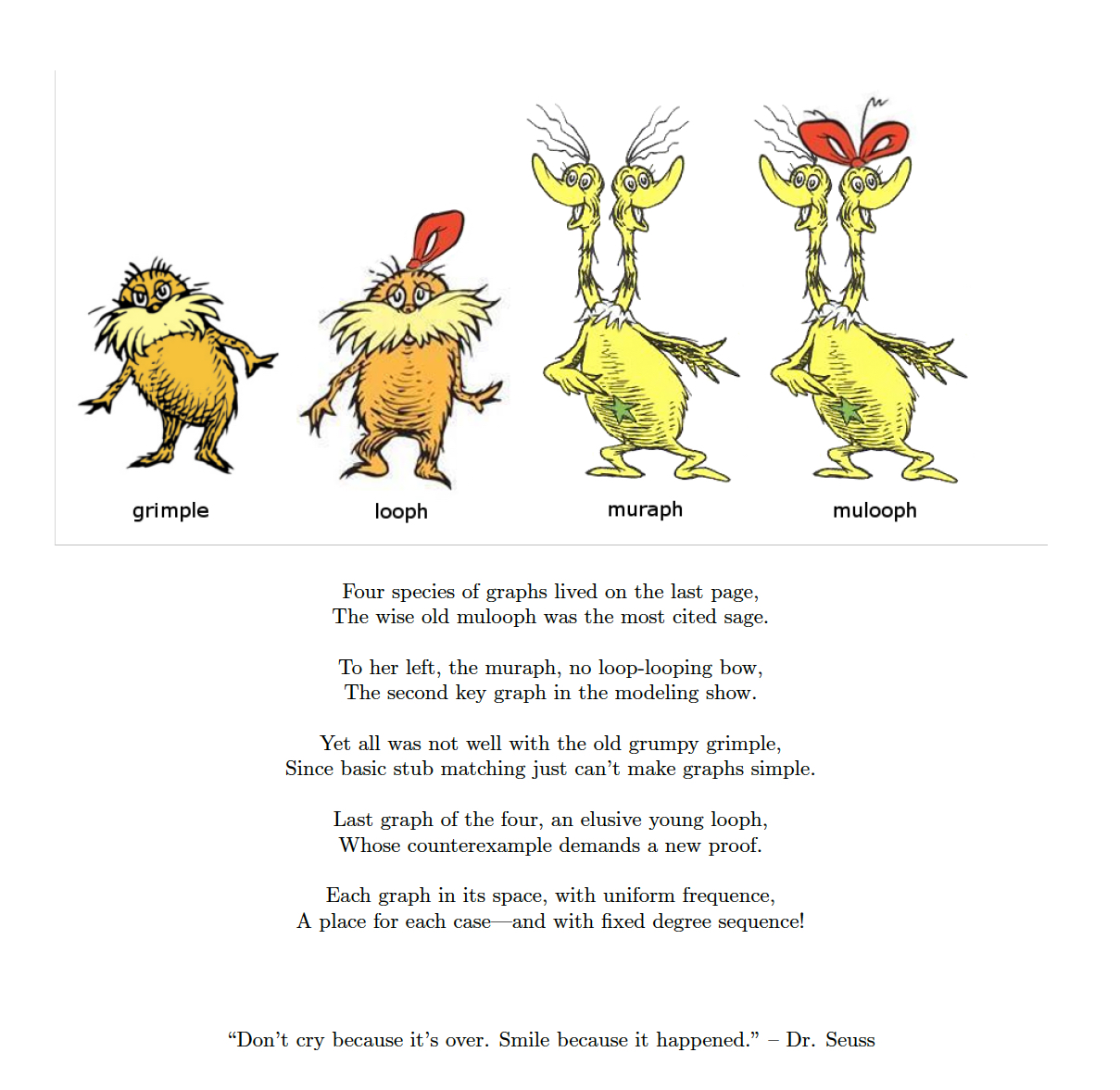
Important Paper on Seussian Configurations of Random-Graph Models
Title: Configuring Random Graph Models with Fixed Degree Sequences
Authors: Bailey K. Fosdick, Daniel B. Larremore, Joel Nishimura, and Johan Ugander
In 2014, Aaron Clauset, David Kempe, and I (with help from Dan Larremore) organized a Mathematics Research Community in Network Science.
In addition to creating a network of network scientists from diverse backgrounds, some work was started there, and today the published version of what is in my opinion an extremely important paper has come out in final form in SIAM Review's 'Research Spotlights' section. I am, of course, talking about the aforementioned paper.
I'm very happy indeed for such excellent work to arise from this.
Congratulations to authors Bailey Fosdick, Daniel Larremore, Joel Nishimura, and Johan Ugander for creating this awesome paper!
I am posting this with an absolutely lovely Seussian picture from an arXiv version of the paper. This picture doesn't appear to have made the cut for the published piece. In addition to its wit and whimsy, a really great thing about the picture and its accompanying verse is that it also encodes the main message of the paper.
Note: I am on the editorial board of the Research Spotlights section of SIAM Review, but I had nothing whatsoever to do with the handling of this paper.
Friday, May 04, 2018
Albert Pujols gets his 3000th Career Hit!
Thursday, May 03, 2018
Awesome Google Doodle
Tuesday, May 01, 2018
Our Memorial Article for Norman J. Zabusky (1929–2018)
Sunday, April 29, 2018
Crib Notes on a Fingernail (with \latex Notation)
My favorite is the use of " \; ", which would allow the cheating student being modeled by the picture to ensure legible symbol spacing when writing exam solutions.
When will academics get rid of tests, quizzes and exams?
— Republic of Math (@republicofmath) April 29, 2018
Cheating at UK's top universities soars by 30%https://t.co/46R8UZHS6I pic.twitter.com/KUDg0RGGCX
Saturday, April 28, 2018
Number of Spaces and Periods
Hurray! Science vindicates my longstanding practice, learned at age 12, of using TWO SPACES after periods in text. NOT ONE SPACE. Text is easier to read that way. Of course, on twitter, I use one space, given 280 characters. https://t.co/4xI6sVbF88 Will arm-wrestle @Neuro_Skeptic pic.twitter.com/XpEr4KFR4x
— Nicholas A. Christakis (@NAChristakis) April 28, 2018
Wednesday, April 25, 2018
Tuesday, April 24, 2018
Balloon Skeleton Animals
Mind-blowing balloon animal skeletons made by Japanese artist Masayoshi Matsumoto https://t.co/K5dvN7WPlt pic.twitter.com/tMXZtHMega
— Scott Kerr (@scott_kerr) April 24, 2018
Monday, April 23, 2018
"Nanoptera in a Period-2 Toda Chain"
Title: Nanoptera in a Period-2 Toda Chain
Authors: Christopher J. Lustri and Mason A. Porter
Abstract: We study asymptotic solutions to a singularly perturbed, period-2 Toda lattice and use exponential asymptotics to examine "nanoptera," which are nonlocal solitary waves with constant-amplitude, exponentially small wave trains. With this approach, we isolate the exponentially small, constant-amplitude waves, and we elucidate the dynamics of these waves in terms of the Stokes phenomenon. We fi nd a simple asymptotic expression for these waves, and we study con figurations in which these waves vanish, producing localized solitary-wave solutions. In the limit of small mass ratio between the two types of particles in the lattice, we derive a simple antiresonance condition for the manifestation of such solutions.
Thursday, April 19, 2018
Manifolds Lying in a Higher-Dimensional Space
Tuesday, April 17, 2018
Tales from the ArXiv: "26 pages and 10 gorgeous figures"
They’re not bad. I wouldn’t call them gorgeous, though.
Sunday, April 15, 2018
Shopping for Groceries and Solving the Reimann Hypothesis
Look at the back of this bag, look carefully at the bottom left corner … 🤩 pic.twitter.com/P5SusNDYtY
— Nalini Joshi (@monsoon0) April 16, 2018
Monday, April 09, 2018
Awesome Journal Idea: Young-Researcher, First-Author Interviews for Accepted Papers
As part of their correspondence today, they also let the first author (my former doctoral student) know about the option of a young-scientist, first-author spotlight. They wrote the following (which you can also find on their website):
Congratulations on acceptance of your article in Biology Open. To help early-career researchers promote themselves alongside their papers, we have launched a series of interviews with the first authors of a selection of papers published in BiO. If you would like to be included in this interview series, please tell us more about yourself by answering the questions below. You can answer all or just some of the questions, and you may also suggest additional questions and provide your answers to them if you wish.
How interesting! I have never seen a journal do this before. What a great idea! We really need to do something like this in the mathematics and physics communities.
Here are their suggested questions:
What is your scientific background and the general focus of your lab?
How would you explain the main findings of your paper to non-scientific family and friends?
What are the potential implications of these results for your field of research?
What has surprised you the most while conducting your research?
What, in your opinion, are some of the greatest achievements in your field and how has this influenced your research?
What changes do you think could improve the professional lives of early career scientists?
What's next for you?
They then added the following:
So that we can create a short biography to accompany your interview, please ensure that you include your job title, the name of the Principal Investigator of your lab, your contact address and a one-line synopsis of your research interests. Include your Twitter handle, if you have one, so we can tag you in any related tweets.
They also asked for a picture of the first author and "a particularly striking, interesting or unusual image" from their research (along with a caption describing it).
Thursday, April 05, 2018
Tales from the ArXiv: Centenary of Emmy Noether's Invariante Variationsprobleme
Title: On the Wonderfulness of Noether's Theorems, 100 Years Later, and Routh Reduction
Author: Raphaël Leone
Abstract: This paper is written in honour of the centenary of Emmy Amalie Noether's famous article entitled Invariante Variationsprobleme. It firstly aims to give an exposition of what we believe to be the most significant and elegant issues regarding her theorems, through the lens of classical mechanics. Despite the limitation to this field, we try to illustrate the key ideas of her work in a rather complete and pedagogical manner which, we hope, presents some original aspects. The notion of symmetry coming naturally with the idea of simplification, the last part is devoted to the interplay between Noether point symmetries and the reduction procedure introduced by Edward John Routh in 1877.
Sunday, April 01, 2018
XKCD: "Right Click"
While navigating the menus, I managed to get eaten by a grue.
There are errors in some of the D & D categorizations.
Some April Fool's Day Stuff
The first one that I want to mention is ThinkGeek's catalog. (Tip of the cap to Jennifer Ouellette.)
As usual, there are some special papers on the arXiv, including this one and this one.
Here is another joke arXiv paper. (Tip of the cap to Chad Topaz.)
Here is a roundup of Google's jokes, including the ability to play "Where's Waldo?" on Google Maps.
Saturday, March 31, 2018
Research Soundtrack
Friday, March 30, 2018
A Pitch for My New Novel
By the way, my d30 (where I rolled again for any results from 27–30) rolled 20 three times during this process, and its only roll below 18 was a single 14, with all but those two rolls in the 20s (including a few of at least 27). Clearly, this is a damage die.
Also, can we get a chart like this for cover letters and grant proposals, please?
P.S. A social media addiction should be contrasted with an antisocial media addiction.
(Tip of the cap to Jennifer Ouellette.)
Wednesday, March 28, 2018
Cover Letters When Responding Reviewers
I read this before at some point, and it's still really funny now. (And also way too close to the truth.)
Definitely adding a Review of Irrelevant Literature to my next paper | https://t.co/MlOLNd3O6E pic.twitter.com/khcbyHydBj
— Academia ɐɹnɔsqO (@AcademiaObscura) March 28, 2018
Tuesday, March 27, 2018
"Interval Signatures of Celebrities and Researchers on Twitter"
It's always nice to be analyzed (for my tweeting behavior) alongside luminaries like Katy Perry, Shaquille O'Neal, and Steve Martin. Lots of my peeps from network and data science are also put under the data-analytic microscope (or perhaps I should write 'mesoscope') on this page.
The Perils of Generating Functions (and Submitting a Note from a Parent with an Exam)
I had this posted on my door at Georgia Tech when I was a postdoc, and I found the note a year ago today when I was going through an old spiral notebook.
As a @Caltech undergraduate, I taught a probability course (Math 1d) and introduced freshmen to the glories of generating functions.
— Mason Porter (@masonporter) March 27, 2018
My exam instructions included a line like: "You may also use a note from your mother, though you won't need one."
One student took me up on it. pic.twitter.com/I2Ocif9ttA
Sunday, March 25, 2018
Congratulations to Dr. Se-Wook Oh!
The title of Se-Wook's thesis is Complex Contagions with Lazy Adoption. You can read about some of Se-Wook's work in our joint paper, which was published recently in Chaos.
Tuesday, March 20, 2018
In Conclusion, Hilarity Ensues.
What Happens in Provo Stays in Provo
I will somehow deal with the fact that I am not allowed to have coffee on campus. :)
Sunday, March 18, 2018
Algorithms in the Form of IKEA Instructions
This is brilliant: Common algorithms explained in the style of IKEA instructions. https://t.co/BIHCed5o0T pic.twitter.com/wTd1DMY2GR
— Thomas Roth (@StackSmashing) March 17, 2018
(Tip of the cap to Lior Pachter.)
We Kid the Statisticians Because We Love Them
Found on the roadside: @SpringerStats yellow book, beside empty vodka bottles & cigarette packs pic.twitter.com/R8LawGlA7W
— Noah Williams (@Bellmanequation) March 18, 2018
(Tip of the cap to Kerstin Nordstrom.)
Saturday, March 17, 2018
Some Really Old Boardgames
I like the cover of "The Magic Ring". :)
Board game aficionados! We dug through @HoughtonLib's archives to find the oldest games in their collections — some created over 300 years ago https://t.co/jbg55aHuyM
— Harvard University (@Harvard) March 17, 2018
(Tip of the cap to Gabrielle Birkman.)
Society for Impure Mathematics (SIM)
Here's a Fun (Alternative) Fact: The Society for Industrial and Applied Mathematics used to be known as "Society for Impure Mathematics" (SIM), because those of us who do applied mathematics are less pure than other types of mathematicians, bless their hearts.
But perhaps this great organization really ought to change its name to "Society for Impure Mathematics", to appease the theoretical mathematicians who like to call themselves "pure" mathematicians.
As you may have gathered, I find the phrasing "pure mathematics" to be incredibly demeaning towards applied mathematics and applied mathematicians. (The term "unadulterated mathematics" is even worse, so I suppose that my subject of choice is "adulterated mathematics".) I really dislike being considered impure, by implication of the term in use. "Pure mathematics" should really be called "theoretical mathematics", just like in every other science.
Additionally, here are two of my tweets on this and related subjects.
From now on, can we say "theoretical mathematics" instead of "pure mathematics"? It's much less obnoxious.
— Mason Porter (@masonporter) August 25, 2017
From me, an impure mathematician
The Mathematics Subject Classification (MSC), required on the AMS cover sheet when applying for US mathematics faculty jobs, is very poorly suited for classifying applied mathematicians and leads to interdisciplinary applicants falling through the cracks.https://t.co/zcJ0vmArv4 pic.twitter.com/6KC4pg2f1y
— Mason Porter (@masonporter) December 2, 2017
Update: I corrected the acronym (I had written "SIP"), because apparently I am having a problem with English today.
Update: If we want to preserve the acronym SIAM and don't mind a bit of redundancy, it can stand for "Society for Impure and Adulterated Mathematics". :)
Visual Illusion: Snakes on a Plane
Snakes appear to move. pic.twitter.com/HggajNQsHY
— Akiyoshi Kitaoka (@AkiyoshiKitaoka) March 17, 2018
(Tip of the cap to Maggie Koerth-Baker.)
Friday, March 16, 2018
Old Article: "On the Fracture of Pencil Points"
Here is an old article on pencil-tip fracture (by Henry Petroski). The picture below, which comes from an even earlier article, sets up the the geometry of a pencil tip.
(I was thinking about this because a 'Number 2' pencil showed up in The Grimm Legacy, which I am currently reading.)
Thursday, March 15, 2018
RIP Philip J. Davis (1923–2018) and Writing Uncountably Many Articles
I have a pet peeve in the above obituary: Don't write sentences like "He wrote countless books, articles, and book reviews imbued with his personal perspective." in the obituary of a mathematician, especially if he is an analyst (with much work in numerical analysis, in this case). Trust me: it's countable (and, actually, it's finite).
For most of us, we'll be more familiar with the many essays and (especially) book reviews that Davis wrote for SIAM News.
(Tip of the cap to the SIAM Twitter account.)
"Title of a Paper"
I’ll soon be giving what amounts to a tutorial for my UCLA Ph.D. students, who will be embarking on writing papers, and — as I was thinking about what materials to prepare — my mind went to a dark, sarcastic place.
— Mason Porter (@masonporter) March 15, 2018
(Inspiration from "Title of the Song" by Da Vinci's Notebook.) pic.twitter.com/N1n3xSY6xr
Update: It turns out that I did this so quickly that I mixed my Oxford and UCLA affiliations. Oops.
Tuesday, March 13, 2018
Best. Erratum. Ever.
This is quite a correction for the misspelling of one author's name by a single letter. pic.twitter.com/PJgwmETSIj
— Retraction Watch (@RetractionWatch) March 13, 2018
(Tip of the cap to Nalini Joshi, whose 'liking' of this tweet led me to find it.)
Saturday, March 10, 2018
Playing Mario Kart on Google Maps to Celebrate Mario Day!
I have a key question: Where are the best places to inflict lightning bolts on people?
In conclusion, come get some!
(Tip of the cap to Gabrielle Birkman, who indicates that there are places to get banana peels and turtle shells.)
The Multiplex Social–Slayage Network of Buffy the Vampire Slayer
The Buffy social network: slayage and love links. https://t.co/xwQ0DoKpAG
— Peter Sheridan Dodds (@peterdodds) March 11, 2018
This figure is definite fodder for talks. Also, if somebody sets up the adjacencies, we should compute some centrality and versatility measures.
Friday, March 09, 2018
Pure Evil Versus Applied Evil
Feedback on Homework Assignments: Getting the Important Stuff Right
You've got to get the important stuff right.
(My submitted feedback also included more substantial comments.)
I also told the lecturer about this in person, of course. :)
#fbf
New Word Proposal: "Scientificially"
It was just a typo, but I may have to adopt this as a new word for when somebody does something artificial in science.
Example usage: "Those data were estimated scientificially to follow a power law."
Wednesday, March 07, 2018
Video project: "Faces of Women in Mathematics"
Quoting the project page: "In February 2018, women mathematicians from all over the world responded to a call for clips in which they were asked to introduce themselves. The result includes 146 clips of 243 women mathematicians from 36 different countries and speaking 31 different languages. Supported by the Committee for Women in Mathematics of the International Mathematical Union."
Take a look at the video!
I met Eugénie, a fellow Somervillian, at last summer's Somerville mathematics reunion (and informal Erdmann-fest). I just found out that she is also a fellow Project NExTer (i.e., a fellow 'dot').
Tuesday, March 06, 2018
"Hyperchaos" in the White House
And now I see this article, which predominantly consists of an interview with nonlinear dynamicist (and pioneer of chaos) Jim Yorke, including discussions about both mathematical chaos and hyperchaos.
Here is how the part with Yorke begins: "That's not chaos, according to James A. Yorke, Distinguished University Professor of Mathematics and Physics at the University of Maryland at College Park." It goes on from there.
Just think about it: Jim Yorke, an expert in chaotic dynamics, was interviewed by CNN about Donald Trump, precisely because of the former's expertise in mathematical chaos. Yup, we've gone full Illuminati.
(Tip of the cap to Bruno Eckhardt and fuzzy sweatshirt particle.)
Monday, March 05, 2018
"Making Sense of Complexity": A Very Nice Introductory Comic Strip
Friday, March 02, 2018
Important Advice from Lego Grad Student to Prospective Graduate Students
It's tempting to fixate on specific professors or features of departments, and to get sold by their pitches. And that all matters. But you never know how your research interests will change over time. What remains constant and critical is the need for caring and supportive peers.
— Lego Grad Student (@legogradstudent) March 2, 2018
Reaction: YES! YES! A million times YES! (And, for the top tweet, I would change "seriously consider" to "absolutely go to".)
P.S. Lego Grad Student is awesome.
Proposal: Use Computational Topology to Study Aversion to Pictures of Holes
For science!
Thursday, March 01, 2018
Is 1 the Loneliest Number?
(Some — most? — versions of the song actually have the line "One is the number divided by two", which is even worse, because of the "the".)
I suppose that this doesn't bother anybody else?
Is There a Mathematical Formula for How Long it Takes for a Child to Ask "Are We There Yet?"?
I was looking at Dwight Barkley's Wikipedia page, and I noticed that apparently he is also known for deriving an equation to estimate how long it will be until a child in a car asks the question "are we there yet?"
You can read about it (and see the equation) in this short article.
"Complex Contagions with Timers"
Title: Complex Contagions with Timers
Authors: Se-Wook Oh and Mason A. Porter
Abstract: There has been a great deal of effort to try to model social influence—including the spread of behavior, norms, and ideas—on networks. Most models of social influence tend to assume that individuals react to changes in the states of their neighbors without any time delay, but this is often not true in social contexts, where (for various reasons) different agents can have different response times. To examine such situations, we introduce the idea of a timer into threshold models of social influence. The presence of timers on nodes delays adoptions—i.e., changes of state—by the agents, which in turn delays the adoptions of their neighbors. With a homogeneously-distributed timer, in which all nodes have the same amount of delay, the adoption order of nodes remains the same. However, heterogeneously-distributed timers can change the adoption order of nodes and hence the “adoption paths” through which state changes spread in a network. Using a threshold model of social contagions, we illustrate that heterogeneous timers can either accelerate or decelerate the spread of adoptions compared to an analogous situation with homogeneous timers, and we investigate the relationship of such acceleration or deceleration with respect to the timer distribution and network structure. We derive an analytical approximation for the temporal evolution of the fraction of adopters by modifying a pair approximation for the Watts threshold model, and we find good agreement with numerical simulations. We also examine our new timer model on networks constructed from empirical data.
Tuesday, February 27, 2018
Children to be Named Later (Best. Erratum. Ever.)
In fact, I think this error is a feature of the book, rather than a bug (especially given that I automatically think of Paul Erdős). By the way, the book itself is awesome, so go take a look at it. Here is a screenshot of the erratum.
(Tip of the cap to my Ph.D. student Yacoub Kureh for pointing this out to me in our meeting today. This erratum is an instant classic.)
Some Very Cool Outdated Words
20 Very Obscure, Very Specific Ancient Jobs eg "Nob Thatcher - Also spelled knob thatcher, this delightful occupation may sound like a Medieval insult, but was the term for a wig-maker." https://t.co/iBrkPdUWWK
— Jennifer Ouellette (@JenLucPiquant) February 27, 2018