Wednesday, June 21, 2023

"Bounded-Confidence Model of Opinion Dynamics with Heterogeneous Node-Activity Levels"

One of my papers came out in final form today. Here are some details.

Title: Bounded-Confidence Model of Opinion Dynamics with Heterogeneous Node-Activity Levels

Authors: Grace J. Li and Mason A. Porter

Abstract: Agent-based models of opinion dynamics allow one to examine the spread of opinions between entities and to study phenomena such as consensus, polarization, and fragmentation. By studying models of opinion dynamics on social networks, one can explore the effects of network structure on these phenomena. In social networks, some individuals share their ideas and opinions more frequently than others. These disparities can arise from heterogeneous sociabilities, heterogeneous activity levels, different prevalences to share opinions when engaging in a social-media platform, or something else. To examine the impact of such heterogeneities on opinion dynamics, we generalize the Deffuant-Weisbuch (DW) bounded-confidence model (BCM) of opinion dynamics by incorporating node weights. The node weights allow us to model agents with different probabilities of interacting. Using numerical simulations, we systematically investigate (using a variety of network structures and node-weight distributions) the effects of node weights, which we assign uniformly at random to the nodes. We demonstrate that introducing heterogeneous node weights results in longer convergence times and more opinion fragmentation than in a baseline DW model. The node weights in our BCM allow one to consider a variety of sociological scenarios in which agents have heterogeneous probabilities of interacting with other agents.

"Lonely Individuals Process the World in Idiosyncratic Ways"

One of my papers that came out a couple of months ago now also has its final volume and page numbers. Here are some details about the article.

Title: Lonely Individuals Process the World in Idiosyncratic Ways

Authors: Elisa C. Baek, Ryan Hyon, Karina López, Meng Du, Mason A. Porter, and Carolyn Parkinson

Abstract: Loneliness is detrimental to well-being and is often accompanied by self-reported feelings of not being understood by other people. What contributes to such feelings in lonely people? We used functional MRI of 66 first-year university students to unobtrusively measure the relative alignment of people’s mental processing of naturalistic stimuli and tested whether lonely people actually process the world in idiosyncratic ways. We found evidence for such idiosyncrasy: Lonely individuals’ neural responses were dissimilar to those of their peers, particularly in regions of the default-mode network in which similar responses have been associated with shared perspectives and subjective understanding. These relationships persisted when we controlled for demographic similarities, objective social isolation, and individuals’ friendships with each other. Our findings raise the possibility that being surrounded by people who see the world differently from oneself, even if one is friends with them, may be a risk factor for loneliness.

Sunday, June 18, 2023

Thursday, June 08, 2023

"Detecting Political Biases of Named Entities and Hashtags on Twitter"

One of my papers came out in final form earlier today. Here are some details. (This is in collaboration with computer scientists, and stylistically it is rather different from much of my work. However, you'll still notice my hand in it. :P)

Title: Detecting Political Biases of Named Entities and Hashtags on Twitter

Authors: Zhiping Xiao, Jeffrey Zhu, Yining Wang, Pei Zhou, Wen Hong Lam, Mason A. Porter, and Yizhou Sun

Abstract: Ideological divisions in the United States have become increasingly prominent in daily communication. Accordingly, there has been much research on political polarization, including many recent efforts that take a computational perspective. By detecting political biases in a text document, one can attempt to discern and describe its polarity. Intuitively, the named entities (i.e., the nouns and the phrases that act as nouns) and hashtags in text often carry information about political views. For example, people who use the term “pro-choice” are likely to be liberal and people who use the term “pro-life” are likely to be conservative. In this paper, we seek to reveal political polarities in social-media text data and to quantify these polarities by explicitly assigning a polarity score to entities and hashtags. Although this idea is straightforward, it is difficult to perform such inference in a trustworthy quantitative way. Key challenges include the small number of known labels, the continuous spectrum of political views, and the preservation of both a polarity score and a polarity-neutral semantic meaning in an embedding vector of words. To attempt to overcome these challenges, we propose the Polarity-aware Embedding Multi-task learning (PEM) model. This model consists of (1) a self-supervised context-preservation task, (2) an attention-based tweet-level polarity-inference task, and (3) an adversarial learning task that promotes independence between an embedding’s polarity component and its semantic component. Our experimental results demonstrate that our PEM model can successfully learn polarity-aware embeddings that perform well at tweet-level and account-level classification tasks. We examine a variety of applications—including a study of spatial and temporal distributions of polarities and a comparison between tweets from Twitter and posts from Parler—and we thereby demonstrate the effectiveness of our PEM model. We also discuss important limitations of our work and encourage caution when applying the PEM model to real-world scenarios.

Saturday, May 13, 2023

What Happens at "Snowbird" Stays at "Snowbird"

Today I am off to the "Snowbird Meeting" (aka the SIAM applied-dynamical systems conference) for the latest instantiation of my favorite scientific conference series.

Wednesday, May 03, 2023

2023 Inductees to the Rock & Roll Hall of Fame

The Rock & Roll Hall of Fame has announced its 2023 inductees.

Of the acts on the ballot this year, the ones for which I cast a vote are Kate Bush (who made it) and Cyndi Lauper, New Order/Joy Division, and Warren Zevon (who didn't).

Saturday, April 22, 2023

What Happens at SOCAMS Stays at SOCAMS

Today I am off to Irvine for the 2023 version of the SOCAMS conference to celebrate applied mathematics in Southern California.

Tuesday, March 28, 2023

What Happens in Vancouver Stays in Vancouver

I am off to Vancouver today for a little while. I'll be giving a talk tomorrow at University of British Columbia, and I'll also be staying with friends and hanging out with them for a while! (On this day 10 years ago, I flew away to visit the same people.)

Monday, March 06, 2023

"Theorems" (to the tune of ' "Heroes" ', by David Bowie)

"Theorems" (to the tune of ' "Heroes" ', by David Bowie)

I, I will be pure
And you, you will use rigor
And nothing will take it away
We can show them, just for one day
We can prove theorems, just for one day

And you, you can have bounds
And I, I'll take infinite time
We're joint authors, and that is a fact
We're coauthors, and that is that
Mathematics'll keep us together
It will not be just for one day
We can prove theorems for ever and ever
What do you say?

I, I wish I could prove
Like my teachers, my teachers can prove
Though sometimes it's hard to keep it together
I can show them, for ever and ever
Oh I can prove Theorems, just for one day

I, I will be pure
And you, you will use rigor
And nothing will take it away
We can prove Theorems, just for one day
We can do it, just for one day

I, I can remember (I remember)
Standing, by the board (by the board)
Arguments, far above our heads (over our heads)
And we tried, and we were never ignored (never ignored)
Our mentors, were always on our side
Oh we can show them, for ever and ever
Then we could prove Theorems, just for one day

We can prove Theorems
Just for one day
We can prove Theorems

We're students, and nothing will help us
Maybe it's hopeless, then you better not stay
But we could graduate, maybe one day

Oh-oh-oh-ohh, oh-oh-oh-ohh, maybe one day?

Friday, February 10, 2023

"An Adaptive Bounded-Confidence Model of Opinion Dynamics on Networks "

An article of mine just appeared in final form a couple of days ago. Here are some details.

Title: An Adaptive Bounded-Confidence Model of Opinion Dynamics on Networks

Authors: Unchitta Kan, Michelle Feng, and Mason A. Porter

Abstract: Individuals who interact with each other in social networks often exchange ideas and influence each other’s opinions. A popular approach to study the spread of opinions on networks is by examining bounded-confidence models (BCMs), in which the nodes of a network have continuous-valued states that encode their opinions and are receptive to other nodes’ opinions when they lie within some confidence bound of their own opinion. In this article, we extend the Deffuant–Weisbuch (DW) model, which is a well-known BCM, by examining the spread of opinions that coevolve with network structure. We propose an adaptive variant of the DW model in which the nodes of a network can (1) alter their opinions when they interact with neighbouring nodes and (2) break connections with neighbours based on an opinion tolerance threshold and then form new connections following the principle of homophily. This opinion tolerance threshold determines whether or not the opinions of adjacent nodes are sufficiently different to be viewed as ‘discordant’. Using numerical simulations, we find that our adaptive DW model requires a larger confidence bound than a baseline DW model for the nodes of a network to achieve a consensus opinion. In one region of parameter space, we observe ‘pseudo-consensus’ steady states, in which there exist multiple subclusters of an opinion cluster with opinions that differ from each other by a small amount. In our simulations, we also examine the roles of early-time dynamics and nodes with initially moderate opinions for achieving consensus. Additionally, we explore the effects of coevolution on the convergence time of our BCM.

Saturday, February 04, 2023

The Dodgers are Finally Retiring Fernando Valenzuela's Uniform Number!

It took way too long, but the Los Angeles Dodgers announced today that they are finally retiring Fernando Valenzuela's uniform number. Given what Fernandro means to this franchise and this city, the team should have retired his number a very long time ago.

Wednesday, January 25, 2023

"The Professional Road that I have Traveled (so far)"

I was asked to write about my career trajectory for DSWeb, so I wrote this short article, which officially has the generic title of "Professional Feature — Mason A. Porter".

I really like my concluding sentence: "I want my mentees to continue to do excellent mentorship and research, be warm and kind-hearted, and not take any crap from anyone."

Scott Rolen Elected to Baseball Hall of Fame!

Yesterday, Scott Rolen was elected to Baseball's Hall of Fame in his 6th year of eligibility. He and Fred McGriff (who was elected to the Hall of Fame by an era committee in December) will be officially inducted into the Hall this summer. I am very pleased that both Rolen and McGriff are now in the Hall of Fame!

Scott Rolen is eminently merits his election, and it's great that he got in after several years of rising vote counts. Todd Helton and Billy Wagner made huge gains this year and should be joining the Hall in 2024. Andruw Jones and Gary Sheffield also made huge gains, although Sheffield is in his last year of eligibility for election by the writers in 2024 and is likely to instead be elected later by an era committee. It now looks like Andruw Jones will likely be elected by the writers in the next few years (but probably not in 2024) after getting under 8% of the vote (!) in his first year of eligibility. Jeff Kent, who was in his 10th and final year of eligibility, surged to 46.5% of the vote and is likely to be elected later by an era committee. Carlos Beltrán debuted on the ballot with 46.5% of the vote (matching Kent). I expect that Beltrán will get up to the high 50s in 2024, have some chance (but unlikely) of election in 2025, and probably be elected in 2026.

A strong set of players is debuting on the Hall ballot for the 2024 cycle. This set of players is led by Adrián Beltré, who will surely be a first-ballot Hall of Famer. Joe Mauer also is debuting on the ballot, but I think it will take 2 or 3 years (most likely 2, in my view) for him to get in. Chase Utley is also debuting in 2024. He'll make it eventually, but his counting stats don't stand out, so it's going to take a few years for him to get in (but I think that he will eventually.)

As in each of the past several years, I was closely tracking the Hall of Fame tracker during the past couple of months as writers released their ballots to the public.

Here is Jay Jaffe's recap of the voting results.

Here are some "way too early" predictions (from Bradford Doolittle David Schoenfield) of Hall of Fame results for the next few cycles. For the most part, my views are far closer to Schoenfield's than the Doolittle's.

Update (1/26/23): Jay Jaffe has written his annual ballot round-up of the candidates on this year's ballot.

Update (1/30/23): Jay Jaffe has written his 5-year Hall prognostication.

Tuesday, January 03, 2023

Sunday, January 01, 2023

"The Topology of Data"

Our introduction to a topological data analysis (TDA) for a general physics audience was published today in Physics Today. Here are some details.

Title: The Topology of Data

Authors: Mason A. Porter, Michelle Feng, and Eleni Katifori

Lede: Topological data analysis, which allows systematic investigations of the “shape” of data, has yielded fascinating insights into many physical systems.

Thursday, December 29, 2022

"Mixed Logit Models and Network Formation"

One of my papers was just published in final form about a week and a half ago. Here are some details.

Title: Mixed Logit Models and Network Formation

Authors: Harsh Gupta and Mason A. Porter

Abstract: The study of network formation is pervasive in economics, sociology, and many other fields. In this article, we model network formation as a ‘choice’ that is made by nodes of a network to connect to other nodes. We study these ‘choices’ using discrete-choice models, in which agents choose between two or more discrete alternatives. We employ the ‘repeated-choice’ (RC) model to study network formation. We argue that the RC model overcomes important limitations of the multinomial logit (MNL) model, which gives one framework for studying network formation, and that it is well-suited to study network formation. We also illustrate how to use the RC model to accurately study network formation using both synthetic and real-world networks. Using edge-independent synthetic networks, we also compare the performance of the MNL model and the RC model. We find that the RC model estimates the data-generation process of our synthetic networks more accurately than the MNL model. Using a patent citation network, which forms sequentially, we present a case study of a qualitatively interesting scenario—the fact that new patents are more likely to cite older, more cited, and similar patents—for which employing the RC model yields interesting insights.

Sunday, December 04, 2022

Fred McGriff Elected to Baseball Hall of Fame!

The Crime Dog (i.e., Fred McGriff) finally has his day, as the latest (and ever-changing) incarnation of a veterans committee has elected him to Baseball's Hall of Fame. Finally!

McGriff was elected unanimously by the 16-member committee. 12 or more votes of the 16-member committee were necessary for election. The other three people who got enough votes for their vote counts to be released are Don Mattingly (8 votes), Curt Schilling (7 votes), and Dale Murphy (6 votes). Everyone else had 3 or fewer votes.

Thursday, November 24, 2022

What Happens in San Juan Capistrano Stays in San Juan Capistrano

I am off to San Juan Capistrano to spend the weekend with friends!

"Nanoptera in Higher-Order Nonlinear Schrödinger Equations: Effects of Discretization"

A paper of mine has just been published in final form. Here are some details about it.

Title: Nanoptera in Higher-Order Nonlinear Schrödinger Equations: Effects of Discretization

Authors: Aaron J. Moston-Duggan, Mason A. Porter, and Christopher J. Lustri

Abstract: We consider generalizations of nonlinear Schrödinger equations, which we call “Karpman equations,” that include additional linear higher-order derivatives. Singularly- perturbed Karpman equations produce generalized solitary waves (GSWs) in the form of solitary waves with exponentially small oscillatory tails. Nanoptera are a special type of GSW in which the oscillatory tails do not decay. Previous research on continuous third-order and fourth-order Karpman equations has shown that nanoptera occur in specific settings. We use exponential asymptotic techniques to identify traveling nanoptera in singularly-perturbed continuous Karpman equations. We then study the effect of discretization on nanoptera by applying a finite-difference discretization to continu- ous Karpman equations and examining traveling-wave solutions. The finite-difference discretization turns a continuous Karpman equation into an advance–delay equation, which we study using exponential asymptotic analysis. By comparing nanoptera in these discrete Karpman equations with nanoptera in their continuous counterparts, we show that the oscillation amplitudes and periods in the nanoptera tails differ in the continuous and discrete equations. We also show that the parameter values at which there is a bifurcation between nanopteron solutions and decaying oscillatory solutions depends on the choice of discretization. Finally, by comparing different higher-order discretizations of the fourth-order Karpman equation, we show that the bifurcation value tends to a nonzero constant for large orders, rather than to 0 as in the associated continuous Karpman equation.

Tuesday, November 22, 2022

2022 Comeback Players of the Year

Baseball's Comeback Players of the Year for 2022 are Justin Verlander of the Detroit Tigers and Albert Pujols of the St. Louis Cardinals.

Thursday, November 17, 2022

2022 Most Valuable Player Awards

Major League Baseball's Most Valuable Player (MVP) awards were announced today. There were no surprises. Paul Goldschmidt of the St. Louis Cardinals is the National League MVP, and Aaron Judge of the New York Yankees is the American League MVP.

The complete voting results for both the NL and the AL are available at this Web page.

Wednesday, November 16, 2022

2022 Cy Young Awards: Both Unanimous!

The 2022 Cy Youngs were announced today, and both of them are unanimous (i.e., received all 1st-place votes). Justin Verlander of the Houston Astros won the American League Cy Young Award, and Sandy Alcántara of the Miami Marlins won the National League Cy Young Award.

I expected Justin Verlander to win, but not to be unanimous. I would have been very surprised if Sandy Alcántara were not unanimous. No other pitchers were anywhere close to Alcántara this year. Only once before have both leagues had unanimous Cy Young Award winners in the same year. That was in 1968, when Denny Mclain won in the AL and Bob Gibson won in the NL.

Tuesday, November 15, 2022

2022 Managers of the Year

Baseball's 2022 Managers of the Year were announced today. Buck Showalter of the New York Mets is the National League Manager of the Year, and Terry Francona of the Cleveland Guardians is the American League Manager of the Year. This is Showalter's 4th MOY award (with four different teams and in four different decades), and this is Francona's third. Both of them will ultimately end up in the Hall of Fame.

Monday, November 14, 2022

2022 Rookies of the Year

The 2022 Rookies of the Year were announced today. Julio Rodríguez won in the American League in a landslide (no surprise), and Michael Harris II beat out teammate Spencer Strider in the National League.

Thursday, November 10, 2022

Some Thoughts on "Statement of Purpose" (SOP) Documents for Graduate-School Applications

Lately, I have been going through statement-of-purpose (SOP) drafts for many UCLA undergraduates, and I have been giving them comments on it.

As a note, I am gearing this predominantly towards mathematics and applied mathematics. In the mathematical sciences in the US, one typically applies directly to graduate programs, rather than to individual faculty members. That entails much freedom in what one wants to work on (in contrast to, e.g., applying to a known project with known funding). Many of my comments should be relevant more broadly, but I wanted to give you this "Surgeon General's Warning" first, as some comments apply most directly to mathematical-science contexts (and especially in the US, as one also often applies directly to faculty or to more specific things in the mathematical sciences in other countries). Also, some parts of what I am writing are more for PhD programs than for Master's programs, but largely these ideas apply to both, aside from certain specifics (such as writing what person you may want as a PhD mentor).

Our students rightly view these documents as pretty mysterious, and these drafts often seem to be presented as chronologies of past experiences. That's not the point, and there is a resume/CV for such things anyway. Some past highlights are certainly relevant, but they need to be in the context of what the student wants to do now, how they got to where they are now and what they want to do, and how this relates to where they are going forward (including the context of the specific university where they are applying to do it). It is common to see too much detail and also to see mind-numbing timelines without the important context. The document should be present-looking and forward-looking.

When I am giving comments on my students' SOPs (along with more general advice on them), the way that I frame this document is as follows:

(1) The document should start with a terse statement of the student's current goal, at whatever level of specificity is accurate for that student. The analogy that I give is the start of a movie, such as an action movie. We start right in the middle of things (possibly in a really tense situation for our hero), and we don't know how they got there. That is also how an SOP should start. For example, I knew that I wanted to do a PhD in applied mathematics (so I applied to PhD programs in applied mathematics and more generally in mathematics) and that I wanted to study something (but I didn't know what) in the topic of dynamical systems. So that is what I said.

(2) One then needs to back up, as in an action movie, and briefly explain/summarize how we got to this point. The chronology and past highlights — including small bits of relevant experience and expertise, but don't overdue it and go at length into too much detail (because you're also submitting a transcript and a resume) — are part of this "backing up" process, but they should specifically be in the context of where one is now. I briefly discussed relevant courses that I had taken and also relevant undergraduate research projects (such as a summer project in geometric mechanics), but again not in too much detail. The idea is to convey how your current interest and goals developed, and past highlights (very specific parts of your personal chronology) can help do that.

(3) Now we have caught up to where our hero is now, and a reader of an SOP has caught up to where the applicant is now. Now you can briefly explain what topics you may want to explore now. That may be a continuation of a subtopic from before, it may be another topic in the same general area, it may be certain applications of that area, or it may be a progression to an adjacent area. Additionally, you don't need to know exactly what you want. Write this bit at whatever level of specificity gives an honest statement of where you are now. If you don't know what you want to work on, it's worth noting that some graduate programs are much more flexible than others. The specificity of what you think you want to work on may influence where you want to apply. Also, notice that I wrote "what you think you want to work on". Your interests will change. Maybe you'll learn about new topics that you didn't encounter before. Maybe some person who seems like a particularly great mentor is another area. Maybe something goes wrong with your intended mentor — unfortunately, this happens way too often — and your interests may change. Flexibility can be a major benefit of a graduate program. In my case, I don't particularly remember what I wrote here, but I expect that mostly just said that I wanted to continue doing dynamical systems. This then leads to connecting these goals and interests to the particular program to which you're applying. That is the next item.

(4) Now you need to briefly indicate why you are a good fit for the specific program to which you're applying, and vice versa. This often takes the form of a short paragraph that is somewhat different for each program to which you apply. For a given type of program (e.g., a PhD program in Mathematics), items (1)--(3) are mostly the same for all of your SOPs. If some programs are slightly different (e.g., some PhD programs and some Master's programs), then there could be two somewhat different versions. In this example, that is one basic one for the Master's programs and one basic one for the PhD programs. OK, I have digressed a bit, so I'll get back to item (4). It's good to indicate in general terms why that program is a good fit for you. In my case, my typical reason was that I wanted to go to places that were both generically "top schools" (where I note the various issues and complications of such a designation) and that were also really strong in applied dynamical systems. For example, that's why I chose to go to Cornell in applied mathematics. For PhD programs, it is also good to indicate potential PhD mentors; indicate who may be a good fit and why. This can simply be a matter of their work being intriguing, but it's good to indicate more direct potential overlap in scientific interests. If possible, listing at least two faculty members is good, and if there is only one person of interest to you, that often may not be the best program choice for you anyway. (See, e.g., my comment above about situations when there are issues with a supervisor.) When the SOP is examined by a committee, the presence of those names may increase the chance that somebody reading your application shows it to those people to ask their views. I have certainly gotten such requests (maybe a handful each year in most years) from my colleagues before. It also shows that you actually looked at the program website and did your homework. That's not bad to convey. Additionally, if there is anything else about the program that appeals to you, it is relevant to briefly mention that as well.

(5) Finally, you're ready to conclude. The movie (i.e., SOP) is about to end, and we need a denouement and the document to end. If you have any thoughts about what you want to do after you get your degree, indicate so. If there is a particular way that the university to which you're applying will help you get there, say that. I think that it's typically best for this text to take the form of a short paragraph. Many people don't know, and that is absolutely fine! But if you do know, it is useful to indicate it. I wanted to go on from my PhD program to a postdoc and then a faculty job, so that's what I said. One can also say that one wants to go to industry, a national lab, do data science for a nonprofit, or whatever else. One can also indicate a couple of these as possibility, since why should most people actually know definitively at this stage.


Good luck!


Note: If I didn't address anything that you feel that would be helpful for me to write in this blog entry, let me know, and I'll add something about it. Or, if I have nothing to say, I can at least remark that the issue exists and point out that I have nothing personal to add.

Friday, November 04, 2022

What Happens in Santa Fe Stays in Santa Fe

I am currently visiting Santa Fe for this event. There is some light snow.

Wednesday, October 26, 2022

"Analysis of Spatial and Spatiotemporal Anomalies Using Persistent Homology: Case Studies with COVID-19 Data"

I'm posting about one of my papers that was published in journal form a couple of months ago. I waited for a while because the journal made surprise, unwanted changes after the galley-proof stage — and unsurprisingly I objected very strongly to what they did — and I tried and failed to get those surprise changes addressed. They are very small, but they annoy me (and, as a matter of principle, they should not have made surprise wording changes between the version that we approved and the version that we published). Anyway, here are some details about the article.

Title: Analysis of Spatial and Spatiotemporal Anomalies Using Persistent Homology: Case Studies with COVID-19 Data

Authors: Abigail Hickok, Deanna Needell, and Mason A. Porter

Abstract: We develop a method for analyzing spatial and spatiotemporal anomalies in geospatial data using topological data analysis (TDA). To do this, we use persistent homology (PH), which allows one to algorithmically detect geometric voids in a data set and quantify the persistence of such voids. We construct an efficient filtered simplicial complex (FSC) such that the voids in our FSC are in one- to-one correspondence with the anomalies. Our approach goes beyond simply identifying anomalies; it also encodes information about the relationships between anomalies. We use vineyards, which one can interpret as time-varying persistence diagrams (which are an approach for visualizing PH), to track how the locations of the anomalies change with time. We conduct two case studies using spatially heterogeneous COVID-19 data. First, we examine vaccination rates in New York City by zip code at a single point in time. Second, we study a year-long data set of COVID-19 case rates in neighborhoods of the city of Los Angeles.

Friday, September 23, 2022

Albert Pujols Hits 700th Career Home Run!

Albert Pujols just became the 4th player in Major League history with 700 or more career home runs (in the regular season). He hit a 2-run homer against the Dodgers in the 3rd and then a 3-run homer against the Dodgers in the 4th. Now we need to work to erase that 5-run deficit. Obviously, congratulations to Albert! What a career!

Wednesday, September 14, 2022

Yadier Molina and Adam Wainwright Make their Record 325th Start as Battery-Mates

Yadier Molina and Adam Wainwright of the St. Louis Cardinals started their record 325th game as battery-mates. They tied the old record last week. Take a look at the Wikipedia page for "battery (baseball)" to see the other top battery-mates.

The new record is going to stand as the record for a very long time, and I'm not sure if it will ever be broken.

Additionally, quoting the ESPN.com article above: "Only six current major league players — Albert Pujols, Nelson Cruz, Miguel Cabrera, Zack Greinke, Rich Hill and Justin Verlander — were active when Wainwright and Molina made their first start together."

Thursday, September 08, 2022

What Happens in Milwaukee Stays in Milwaukee

I am in Milwaukee to give a talk at Marquette tomorrow (and also to see a double-header between the Brewers and the Giants in my first in-person baseball game since before the pandemic). (We arrived during the 6th inning of the first game.) Today was the first non-COVID double-header had Miller Park since 2000. This visit, which was originally slated for May, is my first time in Wisconsin. I have already had some frozen custard, of course.

Thursday, September 01, 2022

An Infinite Loop in the Game Dominion

I managed to construct an infinite loop in Dominion: I am going to break the infinite loop, but you can see in the attached that my turn will last infinitely long if I keep using the 'Shepherd' function that I attached to Estates with Inheritance.

Also, I am almost guaranteed mathematically to be able to do this every turn (and get a Province if I choose to stop); this probability does lessen slightly with each new Province that I acquire. I also pick up a new Estate every turn by using my Hill Fort.

Wednesday, August 31, 2022

RIP Abdul-Aziz Yakubu (1958–2022)

A couple of weeks ago, I heard the very sad and unexpected news that Abdul-Aziz Yakubu had died. Aziz was great.

Like others, I also have some Aziz stories (but the one that I wanted to tell seemed a bit too light-hearted to tell immediately on social media): I know Aziz from my days helping out with MTBI as a PhD student. On one occasion, when somebody — one of the students? — was being a bit formal with my name as I entered a room and was also using my last name or something, I made the mistake of loudly proclaiming "I'm like Madonna. I only need one name." With a quietly wicked sense of humor (and with the knowledge that we'd all be amused by this, including me), Aziz proceeded to jokingly call me "Mason Madonna" for the next several years.

You can read more about Aziz in his 2020 Mathematically Gifted & Black profile.

Tuesday, August 02, 2022

RIP Vin Scully (1927–2022)

I'm watching the game, and the Dodger broadcasters announced about 20 or so minutes ago that broadcasting legend Vin Scully died today. (Scully's death was announced by the Dodgers in the tweet to which I just linked, along with other simultaneous social-media posts.) Vin was the greatest broadcaster who ever lived. I listened to Vin broadcast literally thousands of games across four decades. Vin was one of the key voices of my childhood (and much of my adulthood). For so long, Vin was not only the voice of the Dodgers, but was also (along with Tommy Lasorda) the pulse of the Dodgers.

Here is Vin's Wikipedia page.

Update: ESPN has now posted an article about Vin Scully's death.

Wednesday, July 27, 2022

RIP James Lovelock (1919–2022)

James Lovelock, who proposed the Gaia hypothesis (which postulates that the Earth functions as a self-regulating system) died today. You can read more about him on his Wikipedia page.

When I was in high school, I did a report on the Gaia hypothesis. I suppose that that was my start in complex systems?

(Tip of the cap to Alun Lloyd.)

Sunday, July 24, 2022

What Happens at Santa Fe Institute Stays at Santa Fe Institute

I am heading off to Santa Fe Institute (SFI) for a bit.

Monday, July 18, 2022

RIP Pogo (1998–2022)

Pogo, the infamous cat of Somerville College, died on 26 June at the wizened age of 23 years and 10 months. Pogo's ashes will be scattered in his favorite spot in College just after the memorial for Dame Fiona Caldicott (who, of course, was Pogo's alter ego). That is immensely fitting.

Thursday, July 07, 2022

RIP Mike Brito (1934–2022)

Longtime Dodger scout Mike Brito died today. For many years, Brito was a familiar sight behind the dugout with his cigar.

Tuesday, June 28, 2022

Retirement Conference for Colin Please

Unfortunately, I just checked and I am still COVID positive, so regrettably I will be missing the retirement conference and party for my Oxford colleague Colin Please. (Alhough I am far from perfect, I feel well enough to have attended if I weren't still testing positive. I may chat with some people during a break outside and from a safe distance.)

A more general thing to point out, and it relates to the fact that I already interacted with Colin several years before he joined the Oxford faculty — I wonder if he remembers my antics during the 'mock tutorial' part of his Oxford interview? — is that I have always admired and enjoyed just how tightly know the British applied-mathematics community is. People across some many of the institutions know each other really well and often "randomly" show up at events in nearby cities even when their affiliations are different. I miss that.

Congratulations to Colin on his retirement!

Saturday, June 25, 2022

"Networks of Necessity: Simulating COVID-19 Mitigation Strategies for Disabled People and Their Caregivers"

One of my papers just came out in final form. Here are some details.

Title: Networks of Necessity: Simulating COVID-19 Mitigation Strategies for Disabled People and Their Caregivers

Authors: Thomas E. Valles, Hannah Shoenhard, Joseph Zinski, Sarah Trick, Mason A. Porter, and Michael R. Lindstrom

Abstract: A major strategy to prevent the spread of COVID-19 is the limiting of in-person contacts. However, limiting contacts is impractical or impossible for the many disabled people who do not live in care facilities but still require caregivers to assist them with activities of daily living. We seek to determine which interventions can best prevent infections of disabled people and their caregivers. To accomplish this, we simulate COVID-19 transmission with a compartmental model that includes susceptible, exposed, asymptomatic, symptomatically ill, hospitalized, and removed/recovered individuals. The networks on which we simulate disease spread incorporate heterogeneity in the risk levels of different types of interactions, time-dependent lockdown and reopening measures, and interaction distributions for four different groups (caregivers, disabled people, essential workers, and the general population). Of these groups, we find that the probability of becoming infected is largest for caregivers and second largest for disabled people. Consistent with this finding, our analysis of network structure illustrates that caregivers have the largest modal eigenvector centrality of the four groups. We find that two interventions—contact-limiting by all groups and mask-wearing by disabled people and caregivers—most reduce the number of infections in disabled and caregiver populations. We also test which group of people spreads COVID-19 most readily by seeding infections in a subset of each group and comparing the total number of infections as the disease spreads. We find that caregivers are the most potent spreaders of COVID-19, particularly to other caregivers and to disabled people. We test where to use limited infection-blocking vaccine doses most effectively and find that (1) vaccinating caregivers better protects disabled people from infection than vaccinating the general population or essential workers and that (2) vaccinating caregivers protects disabled people from infection about as effectively as vaccinating disabled people themselves. Our results highlight the potential effectiveness of mask-wearing, contact-limiting throughout society, and strategic vaccination for limiting the exposure of disabled people and their caregivers to COVID-19.

What Happens in the United Kingdom Stays in the United Kingdom

I arrived in Oxford a bit over a week ago, but I forgot to blog about it. I then visited friends in Newcastle during the weekend and returned to Oxford on Monday. Unfortunately, I caught COVID and have thus delayed my return flight to the US. I am currently in a room in Somerville College (in Oxford) struggling through COVID and gradually (but bumpily) improving.

Saturday, June 11, 2022

What Happens in Stockholm Stays in Stockholm

I am about to head to Stockholm for a networks conference that we were supposed to have in 2020. Only a bit late!

This is my first international flight during the COVID era. Meanwhile, I'll also be desperately trying to grade my final projects and finally finish the academic year.

Friday, May 20, 2022

RIP Roger Angell (1920–2022)

Famed writer and editor Roger Angell has died at age 101. Take a look at this article. I hadn't realized it before reading this article, but Angell is from quite a famous family.

Here is Angell's Wikipedia entry.

Thursday, May 19, 2022

"How Do Our Brains Support Our Friendships?"

One of my articles just came out in final published form. Here are some details.

Title: How Do Our Brains Support Our Friendships?

Authors: Elisa C. Baek, Ryan Hyon, Mason A. Porter, and Carolyn Parkinson

Abstract: Have you ever wondered how your friends impact how you see the world? Or how you are able to keep track of the many different people in your life? To study these questions, scientists have begun to look at people’s social networks and their brains at the same time. In this article, we introduce this area of study and discuss how scientists use ideas from both neuroscience and mathematics to examine these questions. We also highlight some recent discoveries that reveal both how our brains support our ability to socialize with others and how our relationships with other people are related to how we use our brains.

Wednesday, May 18, 2022

What Happens in Davis Stays in Davis.

I am off to a short workshop at UC Davis.

However, I just almost accidentally boarded a flight to Hawaii.

I am flying to Sacramento for the workshop at UC Davis.

[I also just noticed: One of the PhD students in my class is actually here and probably on the same flight.]

Saturday, May 14, 2022

A Great Visual Illusion: Radiating the Same Luminance

This is a great visual illusion.

The top and bottom chess pieces radiate the same luminance. (I did some sampling to check, and it seems to check out.)

(Tip of the cap to Luiz Pessoa.)

Wednesday, May 04, 2022

2022 Rock & Roll Hall of Fame Inductees

The Rock & Roll Hall of Fame has announced its 2022 inductees! They include Duran Duran, Eurythmics, Pat Benatar, and Harry Belafonte.

Sunday, May 01, 2022

"Topological Data Analysis of Spatial Systems"

A book chapter of ours was just published in final form. It is Chapter 16 in this book. Here are some other details about it.

Title: Topological Data Analysis of Spatial Systems

Authors: Michelle Feng, Abigail Hickok, and Mason A. Porter

Abstract: In this chapter, we discuss applications of topological data analysis (TDA) to spatial systems. We briefly review a recently proposed level-set construction of filtered simplicial complexes, and we then examine persistent homology in two cases studies: street networks in Shanghai and anomalies in the spread of COVID-19 infections. We then summarize our results and provide an outlook on TDA in spatial systems.

Friday, April 22, 2022

"Role Detection in Bicycle-Sharing Networks Using Multilayer Stochastic Block Models"

A new paper of mine was published in final form today. The project started in January 2017 as a group project by students in the first course that I ever taught at UCLA. It's taken awhile, but we're finally done!

Title: Role Detection in Bicycle-Sharing Networks Using Multilayer Stochastic Block Models

Authors: Jane Carlen†, Jaume de Dios Pont, CassidyMentus, Shyr-Shea Chang, Stephanie Wang, and Mason A. Porter

Abstract: In urban systems, there is an interdependency between neighborhood roles and transportation patterns between neighborhoods. In this paper, we classify docking stations in bicycle-sharing networks to gain insight into the human mobility patterns of three major cities in the United States. We propose novel time-dependent stochastic block models, with degree-heterogeneous blocks and either mixed or discrete block membership, which classify nodes based on their time-dependent activity patterns. We apply these models to (1) detect the roles of bicycle-sharing stations and (2) describe the traffic within and between blocks of stations over the course of a day. Ourmodels successfully uncover work blocks, home blocks, and other blocks; they also reveal activity patterns that are specific to each city. Our work gives insights for the design and maintenance of bicycle-sharing systems, and it contributes new methodology for community detection in temporal and multilayer networks with heterogeneous degrees.

Tuesday, April 12, 2022

A Gallery of Ancience d20 Dice

Here is a gallery of ancient d20 dice. I love it! (It includes the one that I discussed in this post. Also see this post and this post. The second of these also showed up in a previous post.

Also, this reminds me: I need more dice.

(Tip of the cap to Chris Klausmeier.)

Saturday, March 26, 2022

Hence is the Relief Pitcher

Tink Hence, a relief pitcher, is a prospect in the Cardinal's farm system.

I hope that he makes the Majors, so that we can bring back more of these jokes. My favorite one was when Chin Lung Hu came up with the Dodgers; I always wanted him to reach first base.

And Hence's first name is also great. "Tink Hence" is such a great baseball name. Because.

Wednesday, March 16, 2022

Dodgers Sign Freddie Freeman!

The Dodgers have reached a deal with free agent Freddie Freeman. As usual with the Dodgers, it'a Moneyball with money.

Wednesday, March 02, 2022

"In-Degree Centrality in a Social Network is Linked to Coordinated Neural Activity"

Another paper of mine was just published in final form. Here are some details.

Title: In-Degree Centrality in a Social Network is Linked to Coordinated Neural Activity

Authors: Elisa C. Baek, Ryan Hyon, Karina López, Emily S. Finn, Mason A. Porter, and Carolyn Parkinson

Abstract: Convergent processing of the world may be a factor that contributes to social connectedness. We use neuroimaging and network analysis to investigate the association between the social-network position (as measured by in-degree centrality) of first-year university students and their neural similarity while watching naturalistic audio-visual stimuli (specifically, videos). There were 119 students in the social-network study; 63 of them participated in the neuroimaging study. We show that more central individuals had similar neural responses to their peers and to each other in brain regions that are associated with high-level interpretations and social cognition (e.g., in the default mode network), whereas less-central individuals exhibited more variable responses. Self-reported enjoyment of and interest in stimuli followed a similar pattern, but accounting for these data did not change our main results. These findings show that neural processing of external stimuli is similar in highly-central individuals but is idiosyncratic in less-central individuals.

Friday, February 25, 2022

XKCD FTW: Greek Letters

Today's xkcd is fantastic! This is a big win. The mouseover is also great (and I am guilty as charged).

Wait until Randall Munroe finds out about mathfrak…


Thursday, February 17, 2022

What Happens in Austin Stays in Austin

I am in Austin for the wedding of an old college friend. Some of our mutual friends from college are also coming. Yay!

Tuesday, January 25, 2022

David Ortiz Elected to Baseball's Hall of Fame!

The Baseball Hall of Fame results were announced today, and David Ortiz is the only person who was elected by the writers this year. As usual, you can see all of the ballots that have been made public so far at this website. You can also see a discussion of winners and losers from this year's results.

Two of the era committees elected several Hall of Famers last month.

This year, Roger Clemens, Barry Bonds, Curt Schilling, and Sammy Sosa were all in their 10th and final years of eligibility. Clems and Bonds crept up to 65% of the vote, but that's still below the 75% that is needed for induction. Schilling, given his repeated crap, lost many votes. With Clemens, Bonds, Schilling, and Ortiz no longer on the ballot next year and few newcomers of note joining the ballot, holdover Scott Rolen (who went up to around 63% of the vote this year) will likely be elected in 2023 (yay!). Newcomer Carlos Beltrán is the only new person on the ballot next year with any chance. The weak ballot will help him, but we'll see how the Astros cheating scandal affects his vote total. Todd Helton and Billy Wagner finally surpassed 50% of the vote this year, and I expect Todd Helton to make another big jump next year. Both merit election, but it it may take some time for Wagner and I think that Helton is more likely to be elected in 2024 than in 2023. Andruw Jones surpassed 40%, so he's also trending upward. Support for Omar Vizquel tanked because of his shenanigans, and he doesn't belong in the Hall of Fame anyway. Jimmy Rollins and Alex Rodriguez were the only other newcomers to the ballot besides David Ortiz to get at least 5% of the vote.

We will see how the era committees deal with Bonds, Clemens, and Schilling. They'll get into the Hall eventually (as they should, even with their horseshit), but it may take a while.

Update (1/26/22): Also see the voting round-up from Jay Jaffe.

Update (1/27/22): Here is Jay Jaffe's candidate-by-candidate breakdown of the 2022 voting.

Update (1/31/22): Here is Jay Jaffe's five-year outlook of the Hall of Fame balloting in the writers' ballot.

Monday, January 17, 2022

"A Multilayer Network Model of the Coevolution of the Spread of a Disease and Competing Opinions"

A new paper of mine just came out in final form. Here are some details.

Title: A Multilayer Network Model of the Coevolution of the Spread of a Disease and Competing Opinions

Authors: Kaiyan Peng, Zheng Lu, Vanessa Lin, Michael R. Lindstrom, Christian Parkinson, Chuntian Wang, Andrea L. Bertozzi, Mason A. Porter

Abstract: During the COVID-19 pandemic, conflicting opinions on physical distancing swept across social media, affecting both human behavior and the spread of COVID-19. Inspired by such phenomena, we construct a two-layer multiplex network for the coupled spread of a disease and conflicting opinions. We model each process as a contagion. On one layer, we consider the concurrent evolution of two opinions — pro-physical-distancing and anti-physical-distancing — that compete with each other and have mutual immunity to each other. The disease evolves on the other layer, and individuals are less likely (respectively, more likely) to become infected when they adopt the pro-physical-distancing (respectively, anti-physical-distancing) opinion. We develop approximations of mean-field type by generalizing monolayer pair approximations to multilayer networks; these approximations agree well with Monte Carlo simulations for a broad range of parameters and several network structures. Through numerical simulations, we illustrate the influence of opinion dynamics on the spread of the disease from complex interactions both between the two conflicting opinions and between the opinions and the disease. We find that lengthening the duration that individuals hold an opinion may help suppress disease transmission, and we demonstrate that increasing the cross-layer correlations or intra-layer correlations of node degrees may lead to fewer individuals becoming infected with the disease.

Sunday, January 16, 2022

The `PrickRank' Algorithm

One way to gather information is to purposely write an incorrect 'factual' statement on social media.

People love to correct others (often obnoxiously, but at least one acquires info).

Google has PageRank, and social-media platforms like Twitter have this `PrickRank algorithm'.

(This monicker is destined to become a classic, just like FIPO.)

Sunday, January 09, 2022

The Donkey Kong Visual Illusion

This visual illusion ought to be called the "Donkey Kong Illusion"

Thursday, January 06, 2022

"A Bounded-Confidence Model of Opinion Dynamics on Hypergraphs"

A new paper of mine just came out in final form. Here are some details about it.

Title: A Bounded-Confidence Model of Opinion Dynamics on Hypergraphs

Authors: Abigail Hickok, Yacoub Kureh, Heather Z. Brooks, Michelle Feng, and Mason A. Porter

Abstract: People's opinions evolve with time as they interact with their friends, family, colleagues, and others. In the study of opinion dynamics on networks, one often encodes interactions between people in the form of dyadic relationships, but many social interactions in real life are polyadic (i.e., they involve three or more people). In this paper, we extend an asynchronous bounded-confidence model (BCM) on graphs, in which nodes are connected pairwise by edges, to an asynchronous BCM on hypergraphs, in which arbitrarily many nodes can be connected by a single hyperedge. We show that our hypergraph BCM converges to consensus for a wide range of initial conditions for the opinions of the nodes, including for nonuniform and asymmetric initial opinion distributions. We also show that, under suitable conditions, echo chambers can form on hypergraphs with community structure. We demonstrate that the opinions of nodes can sometimes jump from one opinion cluster to another in a single time step; this phenomenon (which we call ``opinion jumping") is not possible in standard dyadic BCMs. Additionally, we observe a phase transition in the convergence time of our BCM on a complete hypergraph when the variance $\sigma^2$ of the initial opinion distribution equals the confidence bound $c$. We prove that the convergence time grows at least exponentially fast with the number of nodes when $\sigma^2 > c$ and the initial opinions are normally distributed. Therefore, to determine the convergence properties of our hypergraph BCM when the variance and the number of hyperedges are both large, it is necessary to use analytical methods instead of relying only on Monte Carlo simulations.

Friday, December 31, 2021

RIP Betty White (1922–2021)

Iconic actress Betty White died today at age 99. January 17 was going to be her 100th birthday. You can read a lot about her on her Wikipedia page.

Thursday, December 30, 2021

"Epidemic Thresholds of Infectious Diseases on Tie-Decay Networks"

Another paper of mine has just been published in final form. (Technically, one could say that it's almost in final form; the issue number has been determined, but its stamp is not yet on the .pdf file as I write this blog entry because some other articles from the same issue haven't yet been published.) Here are some details.

Title: "Epidemic Thresholds of Infectious Diseases on Tie-Decay Networks"

Authors: Qinyi Chen and Mason A. Porter

Abstract: In the study of infectious diseases on networks, researchers calculate epidemic thresholds to help forecast whether or not a disease will eventually infect a large fraction of a population. Because network structure typically changes with time, which fundamentally influences the dynamics of spreading processes and in turn affects epidemic thresholds for disease propagation, it is important to examine epidemic thresholds in models of disease spread on temporal networks. Most existing studies of epidemic thresholds in temporal networks have focused on models in discrete time, but most real-world networked systems evolve continuously with time. In our work, we encode the continuous time-dependence of networks in the evaluation of the epidemic threshold of a susceptible–infected–susceptible (SIS) process by studying an SIS model on tie-decay networks. We derive the epidemic-threshold condition of this model, and we perform numerical experiments to verify it. We also examine how different factors—the decay coefficients of the tie strengths in a network, the frequency of the interactions between the nodes in the network, and the sparsity of the underlying social network on which interactions occur—lead to decreases or increases of the critical values of the threshold and hence contribute to facilitating or impeding the spread of a disease. We thereby demonstrate how the features of tie-decay networks alter the outcome of disease spread.

Thursday, December 23, 2021

"Classical and Quantum Random-Walk Centrality Measures in Multilayer Networks"

Another paper of mine just came out in final form. Here are some details about it.

Title: Classical and Quantum Random-Walk Centrality Measures in Multilayer Networks

Authors: Lucas Böttcher and Mason A. Porter

Abstract: Multilayer network analysis is a useful approach for studying networks of entities that interact with each other via multiple relationships. Classifying the importance of nodes and node-layer tuples is an important aspect of the study of multilayer networks. To do this, it is common to calculate various centrality measures, which allow one to rank nodes and node-layers according to a variety of structural features. In this paper, we formulate occupation, PageRank, betweenness, and closeness centralities in terms of node-occupation properties of different types of continuous-time classical and quantum random walks on multilayer networks. We apply our framework to a variety of synthetic and real-world multilayer networks, and we identify notable differences between classical and quantum centrality measures. Our computations give insights into the correlations between certain centralities that are based on random walks and associated centralities that are based on geodesic paths.

Tuesday, December 14, 2021

"Motifs for Processes on Networks"

Another paper of mine has just been published in final form. Here are some details.

Title: "Motifs for Processes on Networks"

Authors: Alice C. Schwarze and Mason A. Porter

Abstract: The study of motifs can help researchers uncover links between the structure and function of networks in biology, sociology, economics, and many other areas. Empirical studies of networks have identified feedback loops, feedforward loops, and several other small structures as "motifs" that occur frequently in real-world networks and may contribute by various mechanisms to important functions in these systems. However, these mechanisms are unknown for many of these motifs. We propose to distinguish between "structure motifs" (i.e., weakly connected graphlets) in networks and "process motifs" (which we define as structured sets of walks) on networks and consider process motifs as building blocks of processes on networks. Using steady-state covariance and steady-state correlation in a multivariate Ornstein--Uhlenbeck process on a network as examples, we demonstrate that distinguishing between structure motifs and process motifs makes it possible to gain quantitative insights into mechanisms that contribute to important functions of dynamical systems on networks.

Friday, December 10, 2021

"Finding Your Way: Shortest Paths on Networks"

Another article of mine just came out in final form. Here are some details.

Title: Finding Your Way: Shortest Paths on Networks

Authors: Teresa Rexin and Mason A. Porter

Abstract: Traveling to different destinations is a major part of our lives. We visit a variety of locations both during our daily lives and when we are on vacation. How can we find the best way to navigate from one place to another? Perhaps we can test all of the different ways of traveling between two places, but another method is to use mathematics and computation to find a shortest path between them. In this article, we discuss how to construct shortest paths and introduce Dijkstra’s algorithm to minimize the total cost of a path, where the cost may be the travel distance, the travel time, or some other quantity. We also discuss how to use shortest paths in the real world to save time and increase traveling efficiency.

Tuesday, December 07, 2021

Sunday, December 05, 2021

New Hall of Famers from Two of the Era Committees

We have some new Hall of Famers!

The Golden Days Era Committee has elected Tony Oliva, Jim Kaat, Minnie Miñoso, and Gil Hodges to the Hall of Fame. I'm glad that Oliva, Hodges, and (especially) Miñoso are finally in the Hall of Fame. However, Jim Kaat should not have made it, and fellow Golden Era candidate Dick Allen bloody well should be in the Hall of Fame. Take a look at this series of articles for discussions of each of the candidates.

The Early Baseball Era Committee has elected Bud Fowler and Buck O'Neil to the Hall of Fame. Take a look at this series of articles for discussions of each of the candidates.

You can track the regular Hall of Fame ballotting on the usual ballot tracker. I am guessing that they're going to throw a shutout for the second year in a row, but players such as Todd Helton and Scott Rolen (and some others) should make good progress towards eventual election.

Update (12/06/21): As discussed in this article, Dick Allen fell one vote short for the second time in a row. :( Maybe next time, although even then he is no longer alive to enjoy it.

Wednesday, December 01, 2021

What Happens in Salt Lake City Stays in Salt Lake City

I am heading off to Salt Lake City to give a talk at University of Utah!

Saturday, November 27, 2021

"Nanoptera in Weakly Nonlinear Woodpile Chains and Diatomic Granular Chains"

A paper of mine was just published in final form. Here are some details.

Title: Nanoptera in Weakly Nonlinear Woodpile Chains and Diatomic Granular Chains

Authors: Guo Deng, Christopher J. Lustri, and Mason A. Porter

Abstract: We study ``nanoptera," which are nonlocalized solitary waves with exponentially small but nondecaying oscillations, in two singularly perturbed Hertzian chains with precompression. These two systems are woodpile chains (which we model as systems of Hertzian particles and springs) and diatomic Hertzian chains with alternating masses. We demonstrate that nanoptera arise from the Stokes phenomenon and appear as special curves (called Stokes curves) are crossed in the complex plane. We use techniques from exponential asymptotics to obtain approximations of the oscillation amplitudes. Our analysis demonstrates that traveling-wave solutions in a singularly perturbed woodpile chain have a single Stokes curve, which generates oscillations behind the wave front. Comparing these asymptotic predictions with numerical simulations reveals that our asymptotic approximation accurately describes the nondecaying oscillatory behavior in a woodpile chain. We perform a similar analysis of a diatomic Hertzian chain, and we show that each nanopteron solution has two distinct exponentially small oscillatory contributions. We demonstrate that there exists a set of mass ratios for which these two contributions cancel to produce localized solitary waves. This result builds on prior experimental and numerical observations that there exist mass ratios that support localized solitary waves in diatomic Hertzian chains without precompression. Comparing our asymptotic and numerical results for a diatomic Hertzian chain with precompression reveals that our exponential asymptotic approach accurately predicts the oscillation amplitude for a wide range of system parameters, but it fails to identify several values of the mass ratio that correspond to localized solitary-wave solutions.

Monday, November 22, 2021

2021 Baseball Comeback Players of the Year

Baseball's comeback players of the year for 2021 have been announced. The American League winner is Trey Mancini of the Baltimore Orioles, and the National League winner is now-retired Buster Posey of the San Francisco Giants.

Thursday, November 18, 2021

2021 Baseball Most Valuable Player Awards

Baseball announced its 2021 Most Valueable Player Awards today as the culmination of this year's awards. Once again, the results are unsurprising. Shohei Ohtani of the Los Angeles Angels was a unanimous winner in the American League (duh), and Bryce Harper of the Philadelphia Phillies won in the National League.

Wednesday, November 17, 2021

2021 Cy Young Awards

Major League Baseball has announced its 2021 Cy Young Awards for pitching excellence. Robbie Ray of the Toronto Blue Jays won the award in the American League, and Corbin Burnes of the Milwaukee Brewers won in the National League.

The National League race was very close; Burnes narrowly beat out Zack Wheeler of the Philadelphia Phillies and the Los Angeles Dodgers' Max Scherzer wasn't horribly far away either. Walker Buehler of the Dodgers finished 4th in the balloting.

Tuesday, November 16, 2021

2021 Baseball Managers of the Year

Major League Baseball has announced its 2021 Managers of the Year. The Americal League Manager of the Year is Kevin Cash of the Tampa Bay Rays, and the National League Manager of the year is Gabe Kapler of the San Fransisco Giants.

As with the Rookies of the Year, neither winner is surprising.

Monday, November 15, 2021

2021 Baseball Rookies of the Year

The 2021 Rookies of the Year were announced today. Jonathan India of the Cincinnati Reds won in the National League, and Randy Arozarena of the Tampa Bay Rays won in the American League.

Neither choice is surprising.

Some More Trips

I have had a few more short academic trips in the last couple of weeks. I spent a day at Harvey Mudd to talk to the students in Heather Zinn Brooks's class on mathematics and democracy. Then I took a trip to Michigan state to give an applied-mathematics colloquium, and now I am in San Diego State to give a mathematics colloquium.

Wednesday, November 10, 2021

Major League Relievers of the Year

The Mariano Rivera Award and Trevor Hoffmann Award have been awarded to the top relievers in the American League and National League, respectively. Liam Hendricks of the Chicago White Sox won the former, and Josh Hader of the Milwakuee Brewers won the latter.

Friday, November 05, 2021

"Pull Out All the Stops: Textual Analysis via Punctuation Sequences"

One of my papers, which has been available publicly for more than a year, is finally out in final form, with its coordinates (its page numbers and so on). Here are the details.

Title: Pull Out All the Stops: Textual Analysis via Punctuation Sequences

Authors: Alexandra N. M. Darmon, Marya Bazzi, Sam D. Howison, and Mason A. Porter

Abstract: Whether enjoying the lucid prose of a favourite author or slogging through some other writer's cumbersome, heavy-set prattle (full of parentheses, em dashes, compound adjectives, and Oxford commas), readers will notice stylistic signatures not only in word choice and grammar but also in punctuation itself. Indeed, visual sequences of punctuation from different authors produce marvellously different (and visually striking) sequences. Punctuation is a largely overlooked stylistic feature in stylometry, the quantitative analysis of written text. In this paper, we examine punctuation sequences in a corpus of literary documents and ask the following questions: Are the properties of such sequences a distinctive feature of different authors? Is it possible to distinguish literary genres based on their punctuation sequences? Do the punctuation styles of authors evolve over time? Are we on to something interesting in trying to do stylometry without words, or are we full of sound and fury (signifying nothing)?

In our investigation, we examine a large corpus of documents from Project Gutenberg (a digital library with many possible editorial influences). We extract punctuation sequences from each document in our corpus and record the number of words that separate punctuation marks. Using such information about punctuation-usage patterns, we attempt both author and genre recognition, and we also examine the evolution of punctuation usage over time. Our efforts at author recognition are particularly successful. Among the features that we consider, the one that seems to carry the most explanatory power is an empirical approximation of the joint probability of the successive occurrence of two punctuation marks. In our conclusions, we suggest several directions for future work, including the application of similar analyses for investigating translations and other types of categorical time series.

Friday, October 15, 2021

"Detection of Functional Communities in Networks of Randomly Coupled Oscillators Using the Dynamic-Mode Decomposition"

One of my papers just came out in final form last week. Here are some details.

Title: Detection of Functional Communities in Networks of Randomly Coupled Oscillators Using the Dynamic-Mode Decomposition

Abstract: Dynamic-mode decomposition (DMD) is a versatile framework for model-free analysis of time series that are generated by dynamical systems. We develop a DMD-based algorithm to investigate the formation of functional communities in networks of coupled, heterogeneous Kuramoto oscillators. In these functional communities, the oscillators in a network have similar dynamics. We consider two common random-graph models (Watts–Strogatz networks and Barabási–Albert networks) with different amounts of heterogeneities among the oscillators. In our computations, we find that membership in a functional community reflects the extent to which there is establishment and sustainment of locking between oscillators. We construct forest graphs that illustrate the complex ways in which the heterogeneous oscillators associate and disassociate with each other.

Thursday, October 14, 2021

Dodgers Advance to the National League Championship Series!

The Dodgers beat the Giants 2–1 in the elimination game of the NLDS to advance to the National League Championship Series against the Braves!!!

Today was game 5 of the National League Division Series. We were tied 1–1 entering the 9th inning and scored one run in the top of the inning. Max Scherzer entered the game in the bottom of the 9th and earned a save.

The called strike on the check swing to end the game was a really bad call.

Wednesday, October 06, 2021

Dodgers Win Wild Card Elimination Game on a Walk-Off Homerun!

The Dodgers have just beaten the Cardinals in the Wild Card elimination game!

We'll be going to face the Giants (in our first ever postseason series against them) in the National League Division Series!

The Dodgers and Giants had the two best records during the regular season.

Sunday, October 03, 2021

Some Baseball Musings on the Last Day of the 2021 Regular Season

Despite some possibilities for drama, there won't be any Game 163 for any teams. (There was late-inning drama in two of the relevant AL games today, and that is why there won't be any of these extra games.)

We (i.e., the Dodgers) have a win-or-go-home Wild Card 'playoff' against the Cardinals on Wednesday. I'll have it on silent at first while I am participating as a panelist in the UCLA math department job-application panel (which I suggested to our department head that we should do, and thankfully we're doing it), and then I'll have sound on for most of the game once the panel is over.

Trea Turner ended up winning the NL battle title handily. I have trouble picking an MVP, because I think the Padres going into the tank will hurt Tatis Jr.'s chances. That said, I still think he merits it, although if we're going to do pure performance after the Padres fall, maybe Juan Soto ultimately was somewhat better overall? The NL Cy Young award is hard to predict, as a lot of votes will get split. Right now, I think it will be Walker Buehler by a nose over Scherzer, Burnes, and Zack Wheeler. Urías will get some down-ballot votes, but despite the gaudy win totals, the other pitchers I mentioned (and some I have not) have been better them him. Jonathan India will when the NL ROY.

In the AL, Ohtani is the MVP. I think Gerrit Cole is a slightly better Cy Young choice than Robbie Ray, who many announcers seem to think is the heavy favorite. He's a good choice, but I think that Cole has been slightly better. Randy Arozarena is technically still a rookie, but I think I need to look more closely at some of the other viable options as well.

Finally, reports of Joey Votto's demise appear to have been greatly exaggerated (although he has changed his hitting style).

Wednesday, September 15, 2021

"Math Prof" (a parody of “Dentist” from Little Shop of Horrors)

“Math Prof”

(a parody of “Dentist” from Little Shop of Horrors)

[MATHEMATICS PROFESSOR]
When I was younger, just a small geeky kid,
My mama noticed nerdy things I did,
Like countin' all the lights in the ceilings
I'd find their patterns, and after these things
I'd create a small maze and see where it led
That's when my mama said

[POSTDOCS]
What did she say?

[MATHEMATICS PROFESSOR]
She said, "My boy, I think someday
You'll find a way
To make your natural tendencies pay
You'll be a math prof
You have a talent for countin’ things up
Son, be a math prof
People will pay you to be all stuck-up
Your temperament's wrong for the priesthood
And business would suit you still less
Son, be a math prof
You'll be a success

[POSTDOCS]
Here he is, folks, the leader of the proof!
Watch him be oh so aloof!
Oh, my god!
He's a math prof and he'll never ever be any good
Who wants a thesis defense with someone in that mood?

[STUDENT]
Oh that hurts! I don’t know!

[MATHEMATICS PROFESSOR]
Oh, shut up. Think faster. Now go!
I am your math prof

[STUDENT]
Goodness gracious!

[MATHEMATICS PROFESSOR]
And I enjoy the career that I picked

[POSTDOCS]
Really love it

[MATHEMATICS PROFESSOR]
I am your math prof

[STUDENT]
Proving theorems

[MATHEMATICS PROFESSOR]
And I get off on the pain I inflict

[POSTDOCS]
Really love it

[MATHEMATICS PROFESSOR]
I thrill when I ask a tough question

[POSTDOCS]
Tough question
[MATHEMATICS PROFESSOR]
It's swell though they tell me I'm maladjusted
And though it may cause my students distress,
Somewhere, somewhere in Heaven above me
I know, I know, that my mama's proud of me
Oh, mama
'Cause I'm a math prof and a success
Say pi!

[STUDENT]
Pi!

[MATHEMATICS PROFESSOR]
Say mu!

[STUDENT]
Mu!

[MATHEMATICS PROFESSOR]
Say nu!

[STUDENT]
Nu!

[MATHEMATICS PROFESSOR]
Now prove it!

Thursday, September 09, 2021

2021 Ig Nobel Prizes!

The 2021 Ig Nobel laureates have been announced!

I think my favorite one this year is the prize in chemistry, but I of course have fondness for the winners in complex systems (especially with one of them published in Physical Review E).

Thursday, August 26, 2021

What Happens in Boulder Stays in Boulder

I am taking my first trip since January 2020!

I'll be visiting CU Boulder to give an applied-mathematics colloquium. This will also be only my second in-person presentation (I gave one at IPAM a couple of weeks ago) since the start of the pandemic.

I haven't been to Boulder since around 2003 or 2004. I am looking forward to my trip, although traveling is even more nerve-wracking than before.

Friday, August 06, 2021

"Social Network Analysis for Social Neuroscientists"

A paper of mine that was posted in advanced access more than a year ago has now finally been posted in final form. It is a survey and perspective article on social network analysis for social neuroscientists. Here are some details.

Title: Social Network Analysis for Social Neuroscientists

Authors: Elisa C. Baek, Mason A. Porter, and Carolyn Parkinson

Abstract: Although social neuroscience is concerned with understanding how the brain interacts with its social environment, prevailing research in the field has primarily considered the human brain in isolation, deprived of its rich social context. Emerging work in social neuroscience that leverages tools from network analysis has begun to advance knowledge of how the human brain influences and is influenced by the structures of its social environment. In this paper, we provide an overview of key theory and methods in network analysis (especially for social systems) as an introduction for social neuroscientists who are interested in relating individual cognition to the structures of an individual’s social environments. We also highlight some exciting new work as examples of how to productively use these tools to investigate questions of relevance to social neuroscientists. We include tutorials to help with practical implementations of the concepts that we discuss. We conclude by highlighting a broad range of exciting research opportunities for social neuroscientists who are interested in using network analysis to study social systems.

Friday, July 30, 2021

Dodgers Acquire Max Scherzer and Trea Turner!

The Dodgers have made a huge splash in the trade market: they have acquired Max Scherzer and Trea Turner from the Washington Nationals for a load of prospects. This is exactly the trade that we needed. Scherzer, who will eventually be a Hall of Famer, is still an excellent and durable starter; and Turner is an outstanding infielder (who is also rather underrated, in my view, even amidst the wide recognition of his excellence), and I wouldn't be surprised if he eventually also makes the Hall of Fame. Just before then, the Dodgers also acquired pitcher Danny Duffy from the Royals.

Note: I didn't post this yesterday because I wanted to wait until the deal with the Nationals was done, rather than being something that the Dodgers were "finalizing".

Tuesday, July 27, 2021

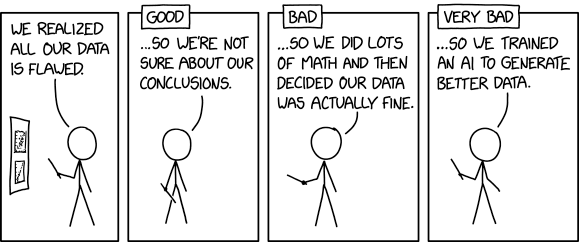
XKCD and Flawed Data

XKCD nailed it yet again, especially with the mouseover text.

Friday, July 16, 2021

My Current Mathematics Genealogy

Here is my current mathematics genealogy.

Thursday, July 08, 2021

"Tie-Decay Networks in Continuous Timeand Eigenvector-Based Centralities"

The paper based on one of my old projects finally appeared in final form. Here are some details.

Title: Tie-Decay Networks in Continuous Timeand Eigenvector-Based Centralities

Authors: Walid Ahmad, Mason A. Porter, and Mariano Beguerisse-Díaz

Abstract: Network theory is a useful framework for studying interconnected systems of interacting entities. Many networked systems evolve continuously in time, but most existing methods for the analysis of time-dependent networks rely on discrete or discretized time. In this paper, we propose an approach for studying networks that evolve in continuous time by distinguishing between interactions, which we model as discrete contacts, and ties, which encode the strengths of relationships over time. To illustrate our tie-decay network formalism, we adapt the well-known PageRank centrality score to our tie-decay framework in a mathematically tractable and computationally efficient way. We apply this framework to a synthetic example and then use it to study a network of retweets during the 2012 National Health Service controversy in the United Kingdom. Our work also provides guidance for similar generalizations of other tools from network theory to continuous-time networks with tie decay, including for applications to streaming data.

Monday, June 28, 2021

"Opinion Dynamics on Tie-Decay Networks"

A new paper of mine just came out in final form. Here are some details.

Title: Opinion Dynamics on Tie-Decay Networks

Authors: Kashin Sugishita, Mason A. Porter, Mariano Beguerisse-Díaz, and Naoki Masuda

Abstract: In social networks, interaction patterns typically change over time. We study opinion dynamics on tie-decay networks in which tie strength increases instantaneously when there is an interaction and decays exponentially between interactions. Specifically, we formulate continuous-time Laplacian dynamics and a discrete-time DeGroot model of opinion dynamics on these tie-decay networks, and we carry out numerical computations for the continuous-time Laplacian dynamics. We examine the speed of convergence by studying the spectral gaps of combinatorial Laplacian matrices of tie-decay networks. First, we compare the spectral gaps of the Laplacian matrices of tie-decay networks that we construct from empirical data with the spectral gaps for corresponding randomized and aggregate networks. We find that the spectral gaps for the empirical networks tend to be smaller than those for the randomized and aggregate networks. Second, we study the spectral gap as a function of the tie-decay rate and time. Intuitively, we expect small tie-decay rates to lead to fast convergence because the influence of each interaction between two nodes lasts longer for smaller decay rates. Moreover, as time progresses and more interactions occur, we expect eventual convergence. However, we demonstrate that the spectral gap need not decrease monotonically with respect to the decay rate or increase monotonically with respect to time. Our results highlight the importance of the interplay between the times that edges strengthen and decay in temporal networks.

Thursday, May 20, 2021

"Topological Data Analysis of Task-Based fMRI Data from Experiments on Schizophrenia"

Another of my papers from an old project final came out in final form after a very long road. Here are some details.

Title: "Topological Data Analysis of Task-Based fMRI Data from Experiments on Schizophrenia"

Authors: Bernadette J. Stolz, Tegan Emerson, Satu Nahkuri, Mason A. Porter, and Heather A Harrington

Abstract: We use methods from computational algebraic topology to study functional brain networks in which nodes represent brain regions and weighted edges encode the similarity of functional magnetic resonance imaging (fMRI) time series from each region. With these tools, which allow one to characterize topological invariants such as loops in high-dimensional data, we are able to gain understanding of low-dimensional structures in networks in a way that complements traditional approaches that are based on pairwise interactions. In the present paper, we use persistent homology to analyze networks that we construct from task-based fMRI data from schizophrenia patients, healthy controls, and healthy siblings of schizophrenia patients. We thereby explore the persistence of topological structures such as loops at different scales in these networks. We use persistence landscapes and persistence images to represent the output of our persistent-homology calculations, and we study the persistence landscapes and persistence images using k-means clustering and community detection. Based on our analysis of persistence landscapes, we find that the members of the sibling cohort have topological features (specifically, their one-dimensional loops) that are distinct from the other two cohorts. From the persistence images, we are able to distinguish all three subject groups and to determine the brain regions in the loops (with four or more edges) that allow us to make these distinctions.

Tuesday, May 18, 2021

"Counterparty Credit Limits: The Impact of a Risk-Mitigation Measure on Everyday Trading"

A paper of mine (from an extremely old project) final came out in final form today. Here are some details.

Title: Counterparty Credit Limits: The Impact of a Risk-Mitigation Measure on Everyday Trading

Authors: Martin D. Gould, Nikolaus Hautsch, Sam D. Howison, and Mason A. Porter

Abstract: A counterparty credit limit (CCL) is a limit that is imposed by a financial institution to cap its maximum possible exposure to a specified counterparty. CCLs help institutions to mitigate counterparty credit risk via selective diversification of their exposures. In this paper, we analyse how CCLs impact the prices that institutions pay for their trades during everyday trading. We study a high-quality data set from a large electronic trading platform in the foreign exchange spot market that allows institutions to apply CCLs. We find empirically that CCLs had little impact on the vast majority of trades in this data set. We also study the impact of CCLs using a new model of trading. By simulating our model with different underlying CCL networks, we highlight that CCLs can have a major impact in some situations.

Friday, May 07, 2021

"Random-Graph Models and Characterization of Granular Networks"

A paper of mine from 2020 now has its final coordinates listed on the published file itself. Here are some details.

Title: Random-Graph Models and Characterization of Granular Networks

Authors: Silvia Nauer, Lucas Böttcher, and Mason A. Porter

Abstract: Various approaches and measures from network analysis have been applied to granular and particulate networks to gain insights into their structural, transport, failure-propagation and other systems-level properties. In this article, we examine a variety of common network measures and study their ability to characterize various two-dimensional and three-dimensional spatial random-graph models and empirical two-dimensional granular networks. We identify network measures that are able to distinguish between physically plausible and unphysical spatial network models. Our results also suggest that there are significant differences in the distributions of certain network measures in two and three dimensions, hinting at important differences that we also expect to arise in experimental granular networks.

Tuesday, April 06, 2021

"Nonlinear Localized Modes in Two-Dimensional Hexagonally-Packed Magnetic Lattices"

One of my papers just came out in final form. Here are some details.

Title: Nonlinear Localized Modes in Two-Dimensional Hexagonally-Packed Magnetic Lattices

Authors: Christopher Chong, Yifan Wang, Donovan Maréchal, Efstathios G. Charalampidis, Miguel Molerón, Alejandro J. Martínez, Mason A. Porter, Panayotis G. Kevrekidis, and Chiara Daraio

Abstract: We conduct an extensive study of nonlinear localized modes (NLMs), which are temporally periodic and spatially localized structures, in a two-dimensional array of repelling magnets. In our experiments, we arrange a lattice in a hexagonal configuration with a light-mass defect, and we harmonically drive the center of the chain with a tunable excitation frequency, amplitude, and angle. We use a damped, driven variant of a vector Fermi–Pasta–Ulam–Tsingou lattice to model our experimental setup. Despite the idealized nature of this model, we obtain good qualitative agreement between theory and experiments for a variety of dynamical behaviors. We find that the spatial decay is direction-dependent and that drive amplitudes along fundamental displacement axes lead to nonlinear resonant peaks in frequency continuations that are similar to those that occur in one-dimensional damped, driven lattices. However, we observe numerically that driving along other directions results in asymmetric NLMs that bifurcate from the main solution branch, which consists of symmetric NLMs. We also demonstrate both experimentally and numerically that solutions that appear to be time-quasiperiodic bifurcate from the branch of symmetric time-periodic NLMs.

Sunday, April 04, 2021

Some Academic Struggles and Survivorship Bias